seogidi.com
A WhatsApp sales funnel takes a buyer from a search result, ad or post straight into a chat, where you answer their question, show the product from your catalogue, send a payment link and follow up until the order is delivered. For many Nigerian online stores it removes the exact steps where web checkouts lose people: account creation, long forms and a payment page from a brand the buyer has never heard of.
That does not mean you should shut your website. The best setup for most Nigerian e-commerce businesses is both: web pages that get found on Google, and a WhatsApp funnel that closes the sale. Here is how to build each part, where each one fails, and what the WhatsApp Business Platform costs after Meta’s October 2026 pricing change.
Why long web checkouts lose buyers
Most people who add something to a cart never pay. Baymard Institute’s running average across 50 studies puts documented cart abandonment at 70.22%. Among shoppers who abandon during checkout, Baymard lists the reasons as extra costs (40%), slow delivery (20%), not trusting the site with card details (19%), being forced to create an account (18%) and a checkout that is too long or complicated (17%).
Those figures come mostly from US shoppers, so treat them as a direction rather than a Nigerian benchmark. The direction is useful, though. Baymard also found the average checkout has 11.3 form fields, when most sites need only 8.
Now add Nigerian conditions. Buyers who have been burnt by “what I ordered vs what I got” want to ask a question first. Delivery fees to Ikorodu and to Lekki are different, and nobody wants to discover that on step four. Many people would rather pay by bank transfer than type card details into an unfamiliar site. A web checkout cannot answer “is this the original?” A person on WhatsApp can.
WhatsApp is already where buyers and sellers are
WhatsApp had a 95% presence on smartphones in KPMG and Orange’s 12-city Nigeria smartphone study, the most widely installed messaging app among respondents. On the seller side, PwC’s Nigeria MSME survey, with fieldwork in 2022, found WhatsApp (23%) was the leading digital channel MSMEs used, ahead of Facebook (19%) and Instagram (15%).
WhatsApp funnel vs web funnel: where each one wins
| Stage | Web funnel | WhatsApp funnel |
|---|---|---|
| Getting found | Strong: product and category pages can rank on Google | Weak: a chat cannot rank. It needs a link, ad, post or QR code to start |
| Answering questions | FAQ sections and reviews, no live answer | A person or saved reply answers in minutes |
| Building trust | Reviews, policies, secure checkout badges | Voice notes, real photos, a named person, past chat history |
| Delivery and fees | Calculated at checkout, often a late surprise | Quoted in chat before the buyer commits |
| Payment | Card checkout, transfer, pay on delivery | Payment link or account number sent in chat |
| Scale | Handles thousands of orders without staff | Limited by how many chats your team can handle |
| Follow-up | Abandoned-cart emails, which many buyers ignore | Direct message to a phone the buyer checks all day |
The pattern is plain. The web is better at being found and at scale. WhatsApp is better at trust and closing. So use the web to bring buyers in, and WhatsApp to close the ones who need a conversation.
How to build a WhatsApp Business funnel, step by step
This is the framework I would set up for a small to mid-size Nigerian store on the free WhatsApp Business app. The features named below are listed on WhatsApp’s own Business app features page.
- Set up the business profile properly. Business name written the same way as on your website and Google Business Profile, address or delivery area, hours, website link and a real logo. This is the first thing a cautious buyer checks.
- Build the catalogue. Add your best sellers with real photos, prices in naira and short descriptions. Group them into collections, such as “Under ₦10,000” or “Men’s sneakers”. WhatsApp lets buyers add catalogue items to a cart and send it to you as one order message.
- Create entry links with a pre-filled message. A click-to-chat link looks like
https://wa.me/234XXXXXXXXXX?text=..., with the number in full international format and no plus sign or leading zero, as Dotdigital’s click-to-chat guide explains. Use a different pre-filled message per source, such as “Hi, I saw the black tote on your website”, so you know where each chat came from. - Write quick replies for the ten questions you get daily. Price, delivery fee by area, delivery time, payment options, returns, sizes, original or not. Quick replies keep answers consistent when two staff share the phone.
- Turn on greeting and away messages. The greeting confirms the buyer reached the right business. The away message tells a 10pm buyer when you will reply, instead of leaving them to message a competitor.
- Send a payment link, not just an account number. Paystack Payment Pages give you a branded link to share in any messaging app, and the buyer pays through Paystack’s checkout. A link with your business name on it reassures buyers more than a personal account number.
- Label every chat. Use labels like New enquiry, Awaiting payment, Paid, Dispatched and Delivered. Labels turn a messy chat list into a pipeline you can count.
- Follow up on a schedule. One polite message to buyers who asked for a price and went quiet, the same day or the next morning. One delivery confirmation. One check-in a few days after delivery asking for a review.
- Move happy buyers into a list you own. Invite them to your broadcast list or WhatsApp Channel for restocks and offers, with their permission.
A worked example (hypothetical)
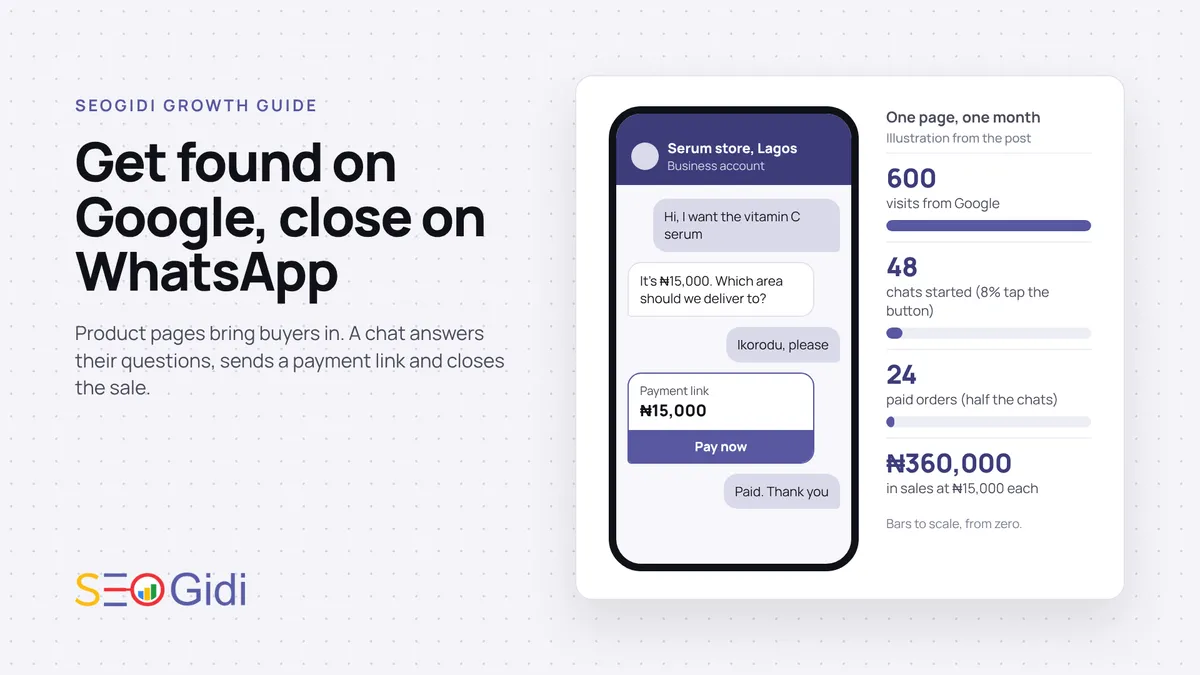
Take a Lagos skincare brand selling a serum at ₦15,000. Its product page ranks for “vitamin C serum for dark spots in Lagos” and gets 600 visits a month. The page shows the price, the delivery fee by zone and a button that opens WhatsApp with “Hi, I want the vitamin C serum” already typed.
Suppose 8% of visitors tap the button, giving 48 chats, and the team converts half of those after answering questions about skin type and delivery. That is 24 orders, or ₦360,000 in sales from one page. These numbers are illustrations, not benchmarks. Your own figures come from counting chats per source and paid orders per label.
Where web pages and SEO still feed the funnel
A WhatsApp funnel has no top of its own. Someone has to tap a link first, and the cheapest steady source of those taps is search.
Buyers type things like “where to buy ankara fabric in Abuja” or “iPhone 13 price in Lagos” into Google. A chat cannot rank for those searches. A product page, a category page or a buying guide can. That is why SEO for ecommerce still matters to a business that closes most sales on WhatsApp: it decides how many people reach the chat button in the first place. The e-commerce SEO practices for African stores apply here unchanged.
A few rules for pages that feed a WhatsApp funnel:
- Show the price on the page. “DM for price” pushes away buyers who are comparing and wastes your team’s time on people who could have checked themselves.
- Put the WhatsApp button next to the price, not hidden in a floating bubble that covers content.
- Keep the page light. If it takes too long to load on mobile data, the buyer never sees the button. My guide to mobile SEO for slow networks covers this.
- Claim your Google Business Profile with the same WhatsApp number, so local searches lead to the chat as well. This is the free foundation in growing a business online without ads.
- Track the click. Set a key event in GA4 for clicks on wa.me links so you can see which pages start chats. Measuring SEO ROI covers how to connect those chats to revenue.
WhatsApp Business app or WhatsApp Business Platform?
The free WhatsApp Business app on a phone is enough for most small stores. The WhatsApp Business Platform (still often called the API) is for businesses that need many agents, chatbots, integrations with an order system, or automated messages at volume. It is used through Meta directly or a Business Solution Provider.
The two have different costs. The app is free. The Platform charges per message, and those charges changed recently.
WhatsApp Business Platform pricing in 2026
Here is what Meta’s developer documentation says today:
- Per-message pricing since 1 July 2025. Meta moved from conversation-based to per-message pricing on 1 July 2025. Marketing and authentication templates are charged, except inside a free entry point window. Utility templates, such as order updates, are charged outside the 24-hour customer service window.
- Service messages are now charged too. Meta’s notice says that from 1 October 2026 it charges per message for all service messages, meaning your free-form replies inside the 24-hour window, and for utility messages sent in response to users. Both had been free.
- The free entry point window remains. When a buyer messages you from a Click to WhatsApp ad or a Facebook Page button and you reply within 24 hours, a 72-hour window opens. Meta says this window is unchanged for message delivery, and service messages in it are listed as free.
- Rates are set per country. Nigeria has its own line on Meta’s rate card. Nigerian reporting, summarised in Dubawa’s fact-check, put service and utility messages at roughly $0.0101 (about ₦14) each and marketing messages at about ₦84. Third-party rate trackers publish different numbers, so check Meta’s current rate card or your provider before you budget.
The same fact-check is clear that personal chats are not affected, and it describes the charges as aimed at businesses messaging customers through the Business Platform. Meta’s pricing pages cover the Platform, not the app, so if you run your store from the app there is no per-message bill to change.
If you are on the Platform, the change matters for funnel design. Every reply now has a small cost, so templates and chatbots should answer the routine questions in fewer messages, and your website should answer price and delivery questions before the chat starts.
Where WhatsApp funnels break
Be honest about the weak points before you move your whole business into a chat app.
- Response time. A buyer who waits three hours has already bought elsewhere. If you cannot staff the phone, set clear hours in your away message.
- Records. Orders that live only in chat history are hard to count, reconcile or hand over to a new staff member. Copy paid orders into a sheet or order system daily.
- One phone, one point of failure. A lost or banned number can take your customer list with it. Back up chats and keep your buyers’ contacts in a list you control.
- Platform risk. Meta sets the rules and the prices, as October 2026 showed. Your website and search visibility are the parts you own.
Frequently asked questions
How do I create a WhatsApp sales funnel?
Start with entry points that open a chat, such as wa.me links on your product pages, Instagram bio and Google Business Profile. Then set up a catalogue, quick replies for common questions, a payment link and labels to track each order’s stage. Finish with a follow-up routine and an invite to your broadcast list or channel.
Can I sell directly with the WhatsApp Business catalogue?
Yes. Buyers can browse your catalogue, add items to a cart and send it to you as one order message. Payment usually happens outside WhatsApp in Nigeria, through a payment link such as a Paystack Payment Page, a bank transfer or pay on delivery.
Is the WhatsApp Business app free in Nigeria?
WhatsApp describes the Business app as free to download. The per-message charges that began on 1 October 2026 apply to businesses on the WhatsApp Business Platform, not to ordinary users or small businesses using the app.
Is a WhatsApp funnel better than a website for e-commerce?
They do different jobs. A website gets found on Google and handles orders at scale, while WhatsApp is better at answering questions and building trust before payment. Most Nigerian stores do best with product pages that rank and a WhatsApp button that closes the sale.
How do I track sales that come from WhatsApp?
Use a different pre-filled message in each wa.me link so you know where each chat started, and record clicks on those links as a key event in GA4. Then label chats by stage and count paid orders per source each week.
If you want to know whether your product pages are bringing enough buyers to the chat button, a free SEO audit is a good place to start.
Reports, articles and industry research, by email
Original Nigerian search data a few times a year, new guides as they are published, and a short note when Google or Meta changes something that affects businesses here. No sales emails, unsubscribe in one click.

Want this done for your business?
Get a free SEO audit: rankings, technical issues, competitor gaps and the quickest wins, within 48 hours.