seogidi.com
Moniepoint did not win Nigerian payments with billboards. By 2021 it had onboarded over 30,000 agents doing 23 million transactions a month, and by its own count it now runs over one million active terminals. The customers came through people standing behind PoS machines on streets where the customers already were.
That is the best growth strategy for most African startups: plug your product into a distribution rail that already carries your customer, such as mobile money, agent networks, USSD, WhatsApp or a marketplace, and treat paid ads as a booster for a channel that already works, not as the channel. Acquiring customers in Africa is mostly a distribution problem. The product question comes second, because a good product that cannot reach people sits in the app store collecting dust.
Why African startup growth is a distribution problem first
Top-of-funnel ads rent attention. You pay, people see you, and when the budget stops, so does the flow. For a startup earning in naira with a thin runway, that rent is the most expensive way to meet a customer who has never heard of you. Wole has already set out the trade-offs between paid channels in social media ads vs search ads, so I will not repeat them here.
The deeper problem is trust. A Lagos trader who has never heard of your app will not hand it her money because a sponsored post told her to. She will try it if her agent, her marketplace or the WhatsApp contact she already buys from puts it in front of her. Rails carry trust as well as traffic.
This is also why so many founders stall early. They build, they launch, they post, and nothing moves. Wole described that pattern in why your startup growth is stuck at zero. Most of the time the missing piece is a pipe to the customer, not another feature.
The five rails that already carry African customers
Each of these rails has tens of millions of people moving through it every month. Your job is to find the one your customer already uses and attach yourself to it.
| Rail | Scale today (sourced below) | How a startup plugs in | What it costs you | Best fit |
|---|---|---|---|---|
| Mobile money | 2.3 billion registered accounts worldwide | Paybill or till integration, merchant onboarding, mini apps | Transaction fees, integration work | Payments, lending, savings, subscriptions in East Africa |
| Agent and PoS networks | 5.90 million active PoS terminals in Nigeria | Agents sell, register or cash in for your product | Agent commission, training, field support | Fintech, insurance, airtime, offline cash users |
| USSD | Works on any phone | Short code menus for sign-up or payment | Short code fees, and the user pays per session | Feature-phone users, rural reach |
| WhatsApp commerce | Nearly 60% of self-employed Nigerian women use it for income | Click-to-chat, catalogue, Business Platform templates | Per-message fees on templates | Retail, services, B2B ordering |
| Marketplaces | Jumia: 2.6 million quarterly active customers | List products, use pickup stations | Commission and fulfilment fees | Physical goods outside Lagos |
Mobile money
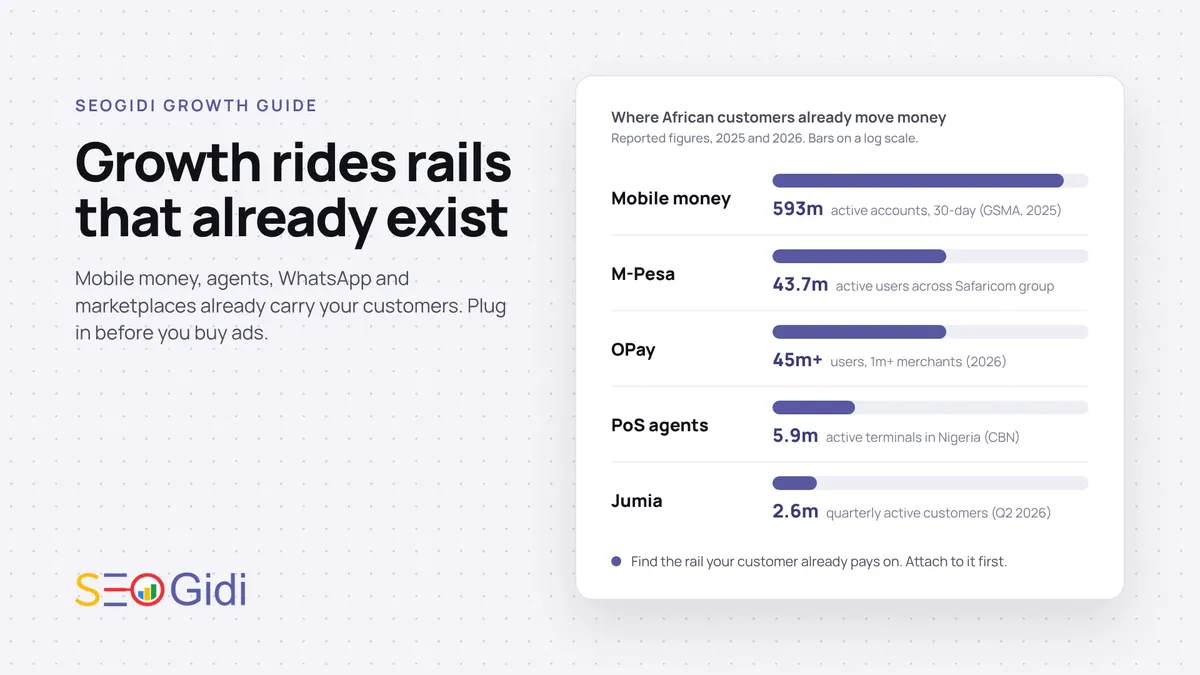
The GSMA reports that over $2 trillion moved through mobile money wallets in 2025, across 2.3 billion registered accounts and 593 million accounts active in a 30-day window, with most new accounts coming from Sub-Saharan Africa.
In Kenya, Safaricom reported 43.69 million active M-Pesa users across the group for its 2026 financial year, and 1 million active Lipa na M-Pesa merchants within a total merchant base of 3.1 million. If your customer is Kenyan, M-Pesa is not a payment option. It is the front door. A product that takes payment through a familiar till number removes the biggest objection before the customer raises it.
Agent and PoS networks
Agents are the human layer of African fintech. They register customers, explain products, take cash and turn it into digital value. Nigeria had about 5.9 million active PoS terminals as of March 2025, according to Central Bank of Nigeria figures reported by TechCabal.
OPay says it has passed 45 million users and over one million merchants, with monthly active transacting users rising to 39.32 million by the end of 2025. Those numbers came through a nationwide network of merchants and agents, not through app-store browsing.
You do not need to build your own network. An insurance startup, a savings product or a utility payment service can partner with an existing agent operator and pay a commission per sign-up or transaction. The agent already has the customer’s trust and the foot traffic.
One warning. Rails come with rules you do not control. In 2025 the CBN ordered PoS terminals to be geo-tagged and limited agent activity to a 10-metre radius of the registered location. Any startup whose model depended on mobile agents had to rethink overnight.
USSD
USSD (Unstructured Supplementary Service Data) is the short code menu you dial, such as *737#, that works on any phone without data. It still matters for feature-phone users and people with no data balance.
The economics changed in 2025. Under the new end-user billing model, each USSD session costs ₦6.98 per 120 seconds, deducted from the subscriber’s airtime. If your flow needs four screens and the user types slowly, you are charging them before they have seen any value. Design USSD flows for one task, finished in under two minutes.
WhatsApp commerce
WhatsApp is where a large share of Nigerian small business already happens. A study by the consultancy Caribou, reported by Semafor, found that nearly 60% of self-employed women in Nigeria use WhatsApp to earn income, the highest of the four countries surveyed.
For a startup this means two things. Your customers will expect to reach you there, and your product can live there. A B2B ordering tool, a delivery service or a lending product can run its first version as a WhatsApp flow before writing a single line of app code.
Know the pricing before you scale it. Since 1 July 2025, Meta has charged the WhatsApp Business Platform per message. Marketing templates are always charged, replies inside an open 24-hour customer service window are free, and when someone messages you from a Click to WhatsApp ad, messages are free for 72 hours if you reply within 24 hours. A flow built on customer-initiated chats is far cheaper than one built on broadcasts.
Marketplaces
If you sell physical goods, a marketplace already has the buyers, the payments and the logistics. In the second quarter of 2026, Jumia reported 2.6 million quarterly active customers and 6.3 million orders, with Nigeria’s GMV up 36% year on year. Two details matter more than the headline. Upcountry regions, meaning outside the main cities, made up 61% of orders, and 75% of packages were collected at pickup stations.
A brand in Lagos that only sells through its own website is likely missing the buyer in Ilorin or Kaduna who trusts a marketplace pickup station more than an unknown courier.
How to choose your distribution rail: a six-step scorecard
Pick one rail first. Startups that try all five at once usually do none of them well. Run this scorecard on your top two candidates.
- Find where the money already moves. Watch ten target customers pay for something similar to what you sell. Note the channel each time: cash to an agent, transfer, M-Pesa, pay on delivery, WhatsApp order.
- Count the steps to first value. List every step from first contact to the customer getting what they paid for. Each extra download, form or OTP loses people. The rail with the fewest steps usually wins.
- Ask what the rail owner gains. Agents want commission and footfall. Marketplaces want selection and margin. Telcos want session revenue. If the deal does not pay the rail owner, it will not last.
- Price the rail in full. Add up commissions, per-message fees, transaction fees and field support per customer acquired. Compare that with your expected revenue per customer in the first six months.
- Run a 30-day test in one city. One rail, one city, one offer. Abuja agents or Nairobi tills or Kano WhatsApp groups. Measure sign-ups, first transactions and second transactions.
- Capture the relationship. Every customer who arrives through a rail should end up with a phone number or WhatsApp opt-in you hold. The rail lends you the customer. The relationship keeps them.
Add a seventh check for anything regulated: read the current CBN, CBK or relevant regulator rules for the rail you depend on, and plan for them changing.
Where ads and search still fit
Rails do not replace marketing. They make it cheaper. Once one rail is converting, paid ads can push more people into it. A Click to WhatsApp ad that opens a working sales flow will usually outperform an ad that sends a stranger to an unfamiliar app download.
Search does a different job. When agents and WhatsApp groups start talking about your product, people search for it. They type your name with “legit”, “charges” or “how to withdraw”. If nothing useful answers them, the trust you built offline leaks away. That is where SEO earns its place, whether you run a fintech that needs to rank for trust queries or an ecommerce brand selling beyond Lagos. Organic visibility also keeps working when budgets dry up, the point I made in no budget for ads? dig the borehole instead.
Common distribution mistakes African startups make
- Building your own agent network on day one. It is slow and capital heavy. Partner first and build only when you have proof.
- Using WhatsApp as a broadcast cannon. Marketing templates cost money every time and annoy people. Let customers start the conversation.
- Depending on one rail with no plan B. A single regulatory circular or platform policy can close the door.
- Treating a Lagos test as a national result. Behaviour in Lekki tells you little about Sokoto or Aba.
- Forgetting the second transaction. A rail can deliver sign-ups that never return. Track repeat use from week one.
Frequently asked questions
What is the best customer acquisition channel for startups in Africa?
There is no single best channel. The best one is the rail your customer already uses to pay or buy, such as M-Pesa in Kenya, agents and PoS in Nigeria, or WhatsApp for small retail. Test one rail in one city for 30 days before adding more.
How do I use WhatsApp to acquire customers?
Make it easy for people to start a chat with you through click-to-chat links on your website, ads and packaging. Answer within the 24-hour service window, where replies are free on the WhatsApp Business Platform. Use paid marketing templates sparingly and only for people who opted in.
Is USSD still worth building for in Nigeria?
Yes, if your customers use feature phones or often have no data. Since mid-2025, users pay for sessions from their airtime, so keep flows short and focused on one task. If most of your users have smartphones and data, a WhatsApp or app flow is usually a better first build.
Do African startups need paid ads at all?
Not at the start. Paid ads work best once a distribution rail already converts, because they then scale something proven. Ads aimed at strangers with no trusted channel behind them tend to burn money fast.
How long does it take to see results from a new distribution channel?
A focused 30-day test in one city will usually tell you whether a rail converts. Building it into a reliable source of customers takes months, and organic search visibility on top of it typically builds over four to eight months for competitive terms.
If you want to know whether your website is ready to catch the people your rails send to Google, start with a free SEO audit.
Reports, articles and industry research, by email
Original Nigerian search data a few times a year, new guides as they are published, and a short note when Google or Meta changes something that affects businesses here. No sales emails, unsubscribe in one click.

Want this done for your business?
Get a free SEO audit: rankings, technical issues, competitor gaps and the quickest wins, within 48 hours.