seogidi.com
On 12 November 2026 Google put a new model, Gemini 4 Hydrogen, into Google Search for every user worldwide. Robby Stein, Google’s VP of Product for Search, called it “the biggest model upgrade to Search yet.” Searchers get AI answers that follow long, messy questions more closely, link to more websites, and show more tables and images.
For a business in Nigeria, the short version is this: Google’s AI answers now go looking for more sources on each part of a question, and they favour pages that answer one thing clearly. That helps smaller, specialised sites that do the work, and it rewards structured content such as comparison tables and published prices.
What Google announced
Google’s post lists four changes, all about the AI answers in Search:
| Change | What Google says | What it means in practice |
|---|---|---|
| Intent | Search handles “questions with multiple parts, hard-to-understand typos, or highly specific requests” | Long, conversational questions get an answer to each part |
| Fan-out and links | Hydrogen’s reasoning improves its query fan-out technique, connecting people to “a broader range of helpful links than before” | More sites can be cited inside one answer |
| Visual answers | More images, structured responses, comparison tables and custom tools | Answers look less like paragraphs and more like a page built for the question |
| Language | Better answers “across all supported AI Mode languages” | Quality improves beyond English |
The post names AI Mode when it talks about languages and does not mention AI Overviews by name, so treat AI Mode as the surface where the change is clearest.
Where Hydrogen sits in the Gemini 4 family
Hydrogen is the fast member of a new model family. PPC Land’s timeline shows Gemini 4 Argon reaching AI Mode for paying AI Pro and Ultra subscribers on 13 October 2026, and Gemini 4 Carbon starting for Ultra subscribers on 10 November. Hydrogen is the first of the three to reach every Search user, free of charge. TechCrunch reports Google’s claim that it completes tasks 2.5 times faster than Gemini 3.8 Flash, Google’s previous fast model. Those speed figures are Google’s own and have not been tested independently.
What query fan-out is, and why it matters most
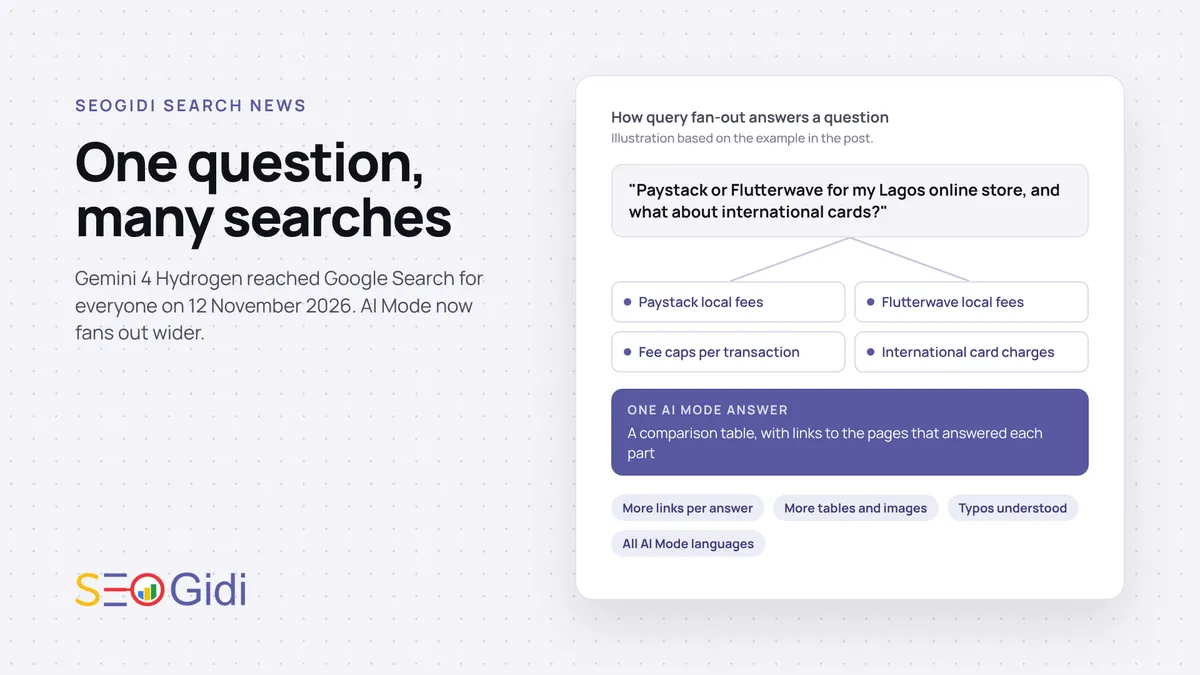
Query fan-out is how AI Mode answers a question. Instead of running one search, it splits your question into many smaller searches on the subtopics, runs them at the same time, and builds the answer from what comes back. PPC Land traces the technique from image search in April 2025 to AI Mode’s subtopic searches in September 2025. Google’s Hydrogen post says the new model does this with “advanced reasoning” and links to sites people “previously might not have discovered.”
Take a question a Lagos shop owner might ask: “Which is cheaper for my online store, Paystack or Flutterwave, and what about international cards?” With fan-out, Search may look up Paystack’s local fees, Flutterwave’s local fees, each company’s fee cap, and international card charges as separate searches, then assemble one answer.
Each of those smaller searches is a chance for a different page to be cited. A big general site that covers everything loosely competes with a small site that answers one sub-question precisely. That is a better deal for specialised businesses than classic search, where one broad page often won the whole query.
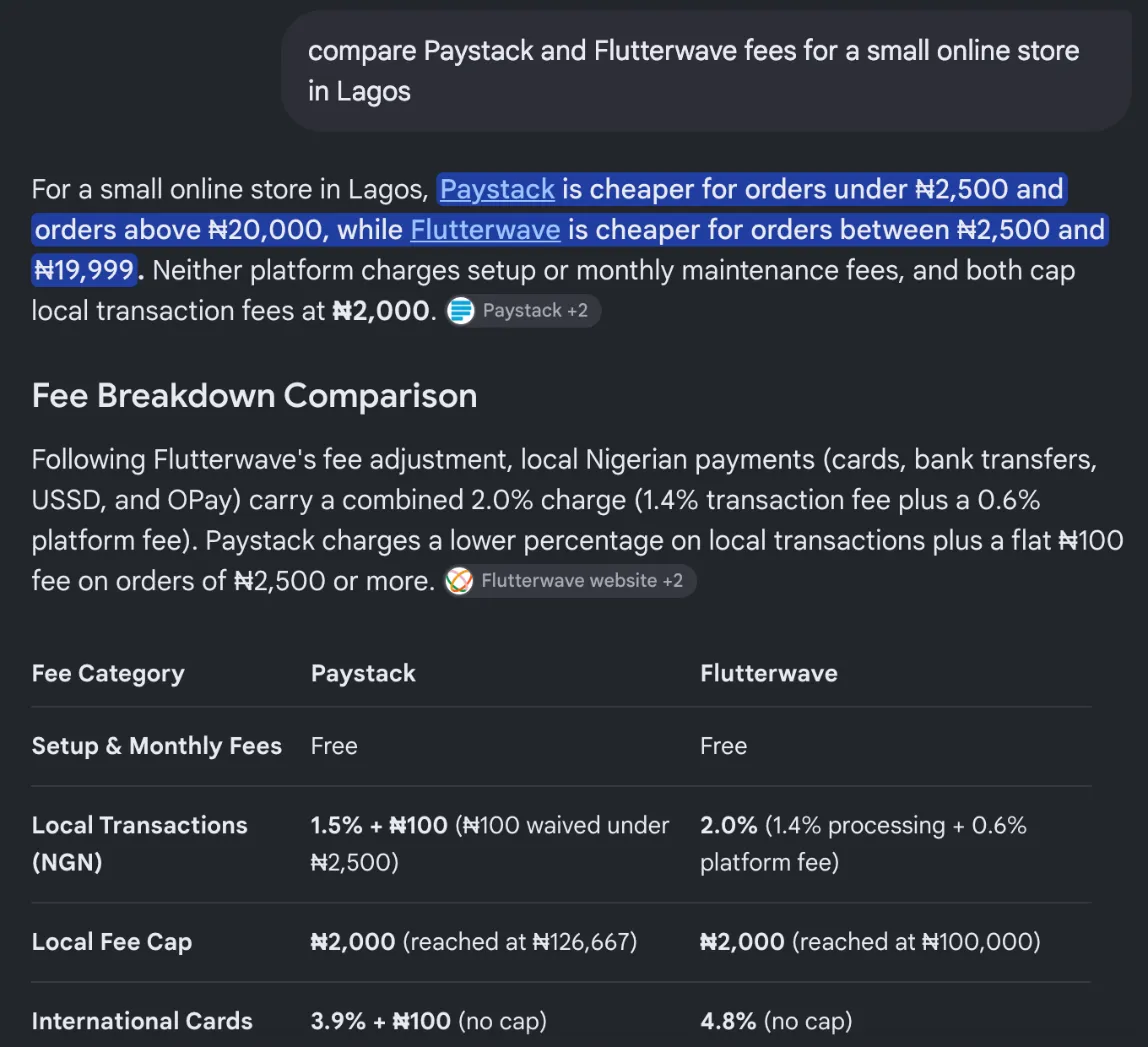
Two things stand out in that answer. It is a table, not a paragraph. And the sources it leans on are the companies’ own pricing pages. When a business publishes its prices plainly, its own page becomes the source the AI quotes.
First impressions from our own tests
Besides the Paystack question, we put two more questions to AI Mode on 13 November, again from a browser in London. A handful of queries is not a study, so treat what follows as first impressions.
Messy English and Pidgin were no problem. We typed: “best way to recieve payment from uk customers for my lagos fashion bizness and how much fee i go pay abeg”. That is two questions, two spelling mistakes and some Pidgin. AI Mode fixed the spelling without comment, answered both parts, and split its advice by how the business sells: orders through Instagram and WhatsApp messages, or checkout on a website. It closed by asking which of the two applies and whether the business is registered with the CAC.
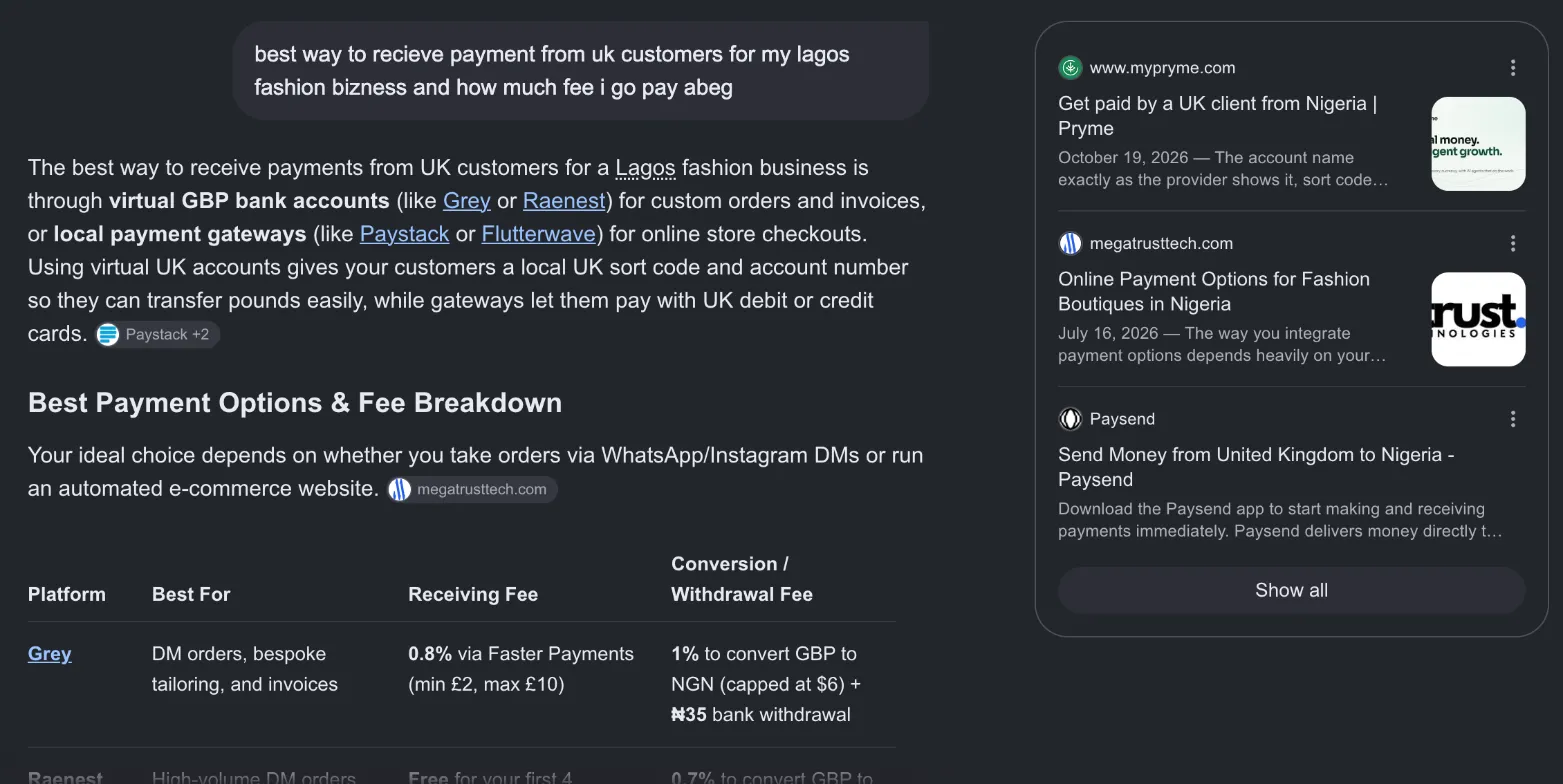
Small specialist sites were cited next to the big brands. The source panel for that answer led with two niche pages, one on mypryme.com about getting paid by a UK client and one on megatrusttech.com about payment options for Nigerian fashion boutiques, with Paysend third. Paystack, Flutterwave, Grey and Raenest appeared as links inside the answer. That fits Google’s description of fan-out: each part of the question went looking for its own best page, and pages written for one narrow question were among the ones used.
Yoruba worked, but no websites were cited. We asked, in Yoruba, how to get a shop in Ibadan to show up on Google. The whole answer came back in Yoruba, step by step, and used real Ibadan areas such as Bodija, Dugbe and Mokola as examples for the address field. Unlike the English answers, it had no source panel and no citation chips. Its only links were to Google Business Profile and Google Maps.
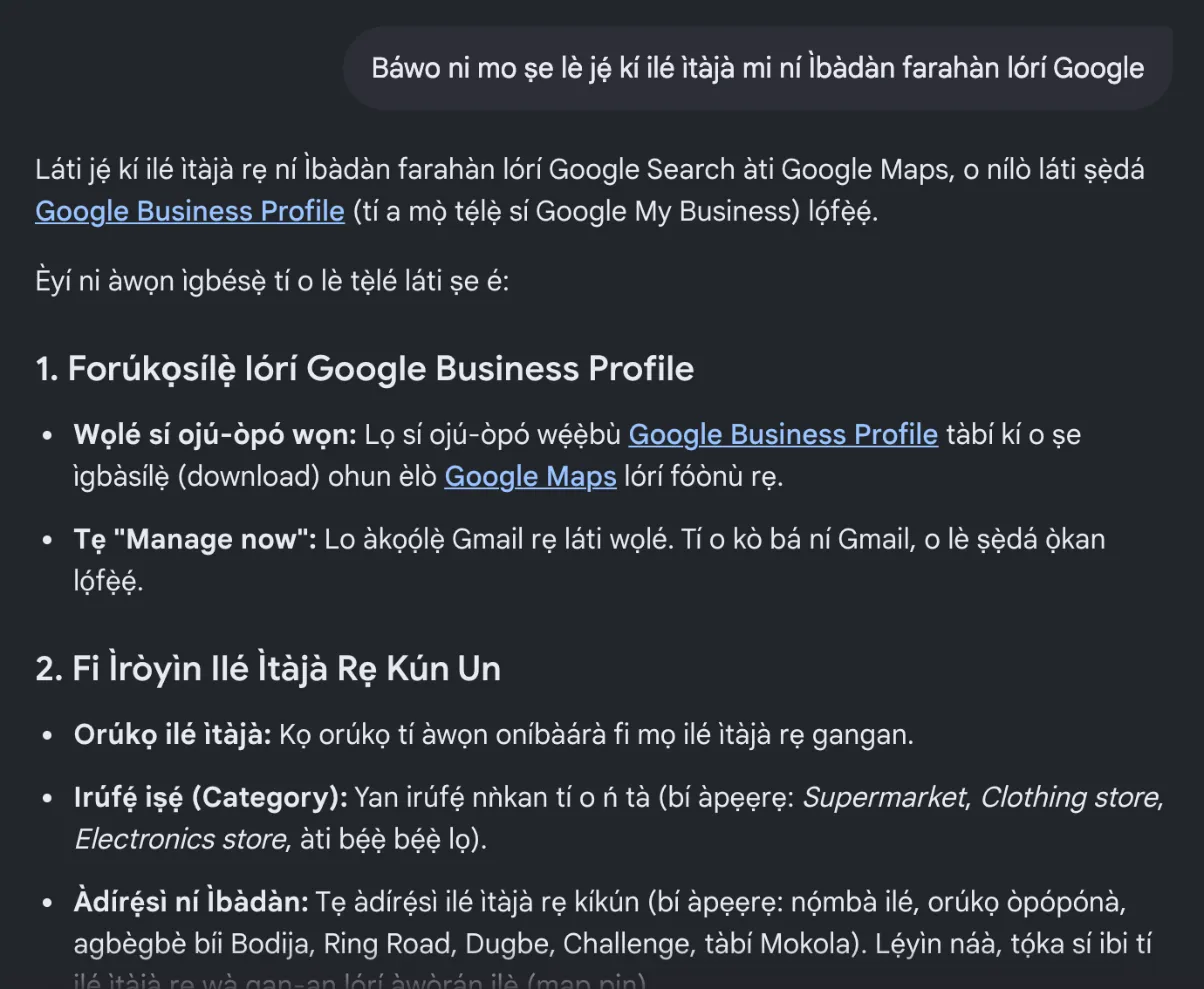
One query cannot tell us why the Yoruba answer cited nobody. If it reflects how little useful Yoruba content exists for questions like this, a business that publishes helpful pages in Yoruba has room to stand out.
Our overall impression: the answers read like a page built for the question, with tables, local detail and a follow-up question to narrow things down. For businesses, the part that matters is who gets cited, and in our English tests that was a mix of brands’ own pricing pages and small, specialised sites.
What this means for your website
Pages that answer one question clearly gain. Fan-out searches for narrow sub-questions. A page titled and written around “how much does a website cost in Lagos” is a better match for one of those searches than a services page that mentions prices somewhere in paragraph nine.
Tables and plain numbers are easier to use. Google now builds more comparison tables in its answers. Content that already holds the comparison, with prices, fees, timelines or features side by side, gives it something to draw on directly. This is also why we put real tables in our own guides.
Long, messy questions are now understood. People type the way they talk: mixed English, local names, spelling mistakes. Google says Hydrogen handles typos and multi-part questions better, so the conversational long tail becomes more valuable. Pages that use the words customers actually use, including local place names, match better.
Language support keeps widening. In March 2026 Google added Yoruba and Hausa to AI Overviews and AI Mode. Hydrogen improves answers across the languages AI Mode supports. If your customers search in Yoruba or Hausa, content in those languages has a clearer path into AI answers than before.
Clicks are not guaranteed. Google says Hydrogen connects people to more links. It does not say those links get more clicks, and a richer answer can also mean fewer reasons to leave Google. Measure before you assume either way.
Five things to do this month
- Publish your prices and key facts in plain text. Put fees, packages, delivery times and locations on your own site, in a table where it fits. If the AI is going to quote someone on your prices, it should be you.
- Give each important question its own page or section. Use the question as a heading and answer it in the first two sentences below it. One clear answer per section suits fan-out.
- Add tables wherever there is a real comparison. Plan against plan, city against city, option against option. Use proper HTML tables, not images of tables.
- Write the way your buyers ask. Pull the exact wording from customer chats, WhatsApp messages and the queries in Search Console, and use it in headings and FAQs.
- Watch your AI visibility monthly. Open the generative AI report in Search Console and note your AI impressions and which pages appear. Compare December with November to see whether Hydrogen moved anything for you.
Speed still matters for the people who do click through, most of them on phones and mobile data. A website built for Nigerian phones is the starting point.
How this fits the bigger picture
Hydrogen does not change the fundamentals of being found. It raises the reward for doing them properly. The businesses that already answer real questions plainly, publish real numbers and keep their facts consistent across their site and Google Business Profile will gain most. We set out the wider approach in our guide to GEO and AEO for Nigerian businesses and on our generative engine optimisation page. If you want the traffic side of the argument, our piece on whether AI Overviews reduce website traffic looks at what the studies found.
Frequently asked questions
What is Gemini 4 Hydrogen in Google Search?
It is a new Google AI model that powers AI answers in Search. Google rolled it out to all users globally on 12 November 2026 and described it as the biggest model upgrade to Search yet. It improves how Search reads complex questions, how many sites it links to, and how visual its answers are.
Does Gemini 4 Hydrogen affect normal Google rankings?
Google’s announcement is about AI answers, mainly in AI Mode, not the ranking of ordinary blue links. There is no sign in the post of a change to classic ranking. Your organic rankings and your visibility in AI answers can move separately, which is why it pays to track both.
What is query fan-out?
It is the method AI Mode uses to answer a question: it breaks the question into several smaller searches on its subtopics, runs them at the same time, and builds one answer from the results. Each smaller search is a chance for a different site to be cited.
How can my business appear in Google AI Mode answers?
Answer specific questions clearly on your own site, publish your prices and key facts in plain text, use tables for comparisons, and keep your details consistent across your site and Google Business Profile. Nobody can guarantee a citation, but these steps make your pages easier for the AI to use.
What is Gemini 4 Hydrogen like to use?
In our first tests on 13 November, AI Mode handled misspelt, mixed English and Pidgin questions well, answered every part of multi-part questions, and often replied with a table. It also answered a Yoruba question fully in Yoruba, though that answer cited no outside websites.
Is Gemini 4 Hydrogen available in Nigeria?
Google says Hydrogen is available globally in Google Search for all users, so it applies to searches made in Nigeria too.
If you want to see how your business shows up in Google’s AI answers today, request a free SEO audit. It includes a check of whether ChatGPT, Gemini and Google AI Mode name your business.
Reports, articles and industry research, by email
Original Nigerian search data a few times a year, new guides as they are published, and a short note when Google or Meta changes something that affects businesses here. No sales emails, unsubscribe in one click.

Want this done for your business?
Get a free SEO audit: rankings, technical issues, competitor gaps and the quickest wins, within 48 hours.