seogidi.com
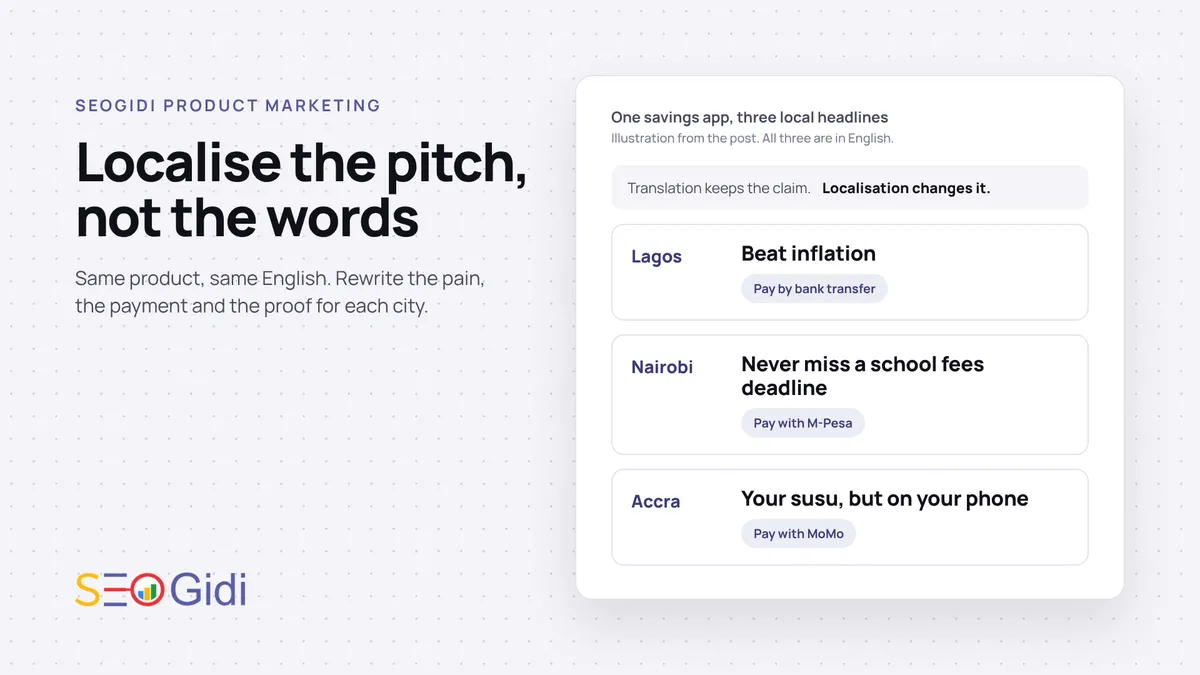
To localise product messaging for African markets, you rewrite three things for each city: the pain your product removes, the way people will pay for it, and the proof that makes a stranger believe you. Translation changes the words. Localisation changes the argument. A savings app that sells “beat inflation” in Lagos may need to sell “never miss a school fees deadline” in Nairobi and “your susu, but on your phone” in Accra, all in English.
Language still matters. A 2020 CSA Research survey of 8,709 consumers in 29 countries found that 76% of online shoppers prefer product information in their own language, and 40% will never buy from websites in other languages. But most African buyers your startup targets first will read English well. Their resistance is rarely about vocabulary. It is about whether your message sounds like it was written for their street, their wallet and their fears.
Localisation vs translation: what is the difference in marketing?
Translation is converting text from one language into another while keeping the meaning. Localisation is adapting the whole offer so it makes sense in a specific market: the examples, the prices, the payment options, the social proof, the tone and sometimes the product itself.
Here is a quick way to tell which one you are doing.
| Element | Translation | Localisation |
|---|---|---|
| Headline | Same claim, new language | New claim built on a local pain point |
| Prices | Converted at today’s rate | Set in local currency at a locally sensible price point |
| Payment cues | Card logos copied over | Bank transfer, M-Pesa or MoMo shown where people expect them |
| Proof | Global testimonials | Named local customers, local regulators, local press |
| Tone | Grammatically correct | Sounds like a person from that city wrote it |
| Images | Stock photos | Recognisable streets, shops, faces and phones |
A Nigerian founder expanding to Kenya does not need a translator. They need someone who knows why a Nairobi shop owner trusts one payment prompt and ignores another.
Why one “African” message fails in Lagos, Nairobi and Accra
The three cities share English as a business language and very little else in how people buy online. The numbers alone tell you the markets are shaped differently.
According to DataReportal’s Digital 2026 reports, Nigeria had 109 million internet users in October 2025, a 45.5% penetration rate. Kenya had 23.4 million internet users, or 40.5% of the population. Ghana had 26.3 million internet users, 74.6% of the population.
Payment habits differ even more. Nigeria’s electronic payments, led by instant bank transfers, reached ₦1.07 quadrillion across 11.2 billion transactions in 2024, according to NIBSS figures reported by Nairametrics. In Kenya, Safaricom reported 46.4 billion M-Pesa transactions in the year to March 2026. In Ghana, mobile money transactions reached GH¢4.54 trillion in 2025, with active customers rising to 26.7 million, per the Bank of Ghana.
| Lagos (Nigeria) | Nairobi (Kenya) | Accra (Ghana) | |
|---|---|---|---|
| Default way to pay online | Bank transfer, cards, USSD | M-Pesa, Till and Paybill numbers | Mobile money (MoMo), cards |
| Everyday language mix | English, Pidgin, Yoruba | English, Swahili, Sheng | English, Twi, Ga |
| Trust question buyers ask | “Is this a scam?” | “Can I pay with M-Pesa?” | “Can I pay with MoMo?” |
| What proof lands | CBN licence, named reviews, a physical address | Safaricom integration, local brands using you | Bank of Ghana licence, local partners |
The third row is a judgement call, not survey data. If your landing page answers the Lagos question in Nairobi, it answers the wrong question.
Start with the local pain point, not the feature
The feature list rarely changes between markets. The reason people care does.
Take an invoicing tool for small businesses, as an illustration. In Lagos, the sharpest pain may be chasing customers who say “I have sent it” when no transfer has arrived. The message becomes: “See every transfer the moment it lands. No more screenshots.” In Nairobi, where many small businesses already receive payments into a Till number, the pain may be reconciling M-Pesa statements at month end. The message becomes: “Match every M-Pesa payment to an invoice automatically.” Same product. Two different first sentences.
To find these pains, do not guess from a desk in Lekki. Run ten short calls per city with people who fit your target customer, and write down the exact phrases they use. If you need a structure for those calls, our post on talking to your users before you build more lays one out.
Then check search behaviour. The words people type into Google in Accra are evidence of how they describe the problem. A Ghanaian searching “MoMo payment for my shop” and a Nigerian searching “POS for small business” may want the same thing, and your page has to meet each of them in their words. This is where matching content to search intent stops being an SEO exercise and becomes a messaging one.
Payment and trust cues belong in the message, not the footer
In many African markets, the payment method is part of the value proposition. A buyer deciding whether to try you is often deciding whether paying you feels safe.
Jumia’s own numbers show how slowly prepaid habits move. In Q2 2025 the company reported about 1.4 million JumiaPay transactions against 5.0 million total orders, and it describes JumiaPay as a way to track “the progressive conversion of cash on delivery orders into prepaid orders.” That tells you many buyers still want to see the goods before money leaves their account.
What this means for your messaging:
- Name the local payment method in the headline area, not only at checkout. “Pay with M-Pesa” near the call to action does more in Nairobi than a row of card logos.
- In Nigeria, state who holds the money and what happens if something goes wrong. A refund promise in plain words reduces the “is this a scam” hesitation.
- Show local prices in local currency, with a number that feels normal for that market. A price ending in ₦9,999 reads differently from one converted to ₦9,847 at today’s rate.
- Use proof that a local buyer can check: a registered business name, a licence number where you have one, reviews from named people in that city.
If trust is your main conversion problem, our piece on why social proof beats ads goes further on what kinds of proof work.
Pidgin, Sheng and Twi: when local language helps and when it hurts
Local language can make a brand feel close. It can also make it look like it is trying too hard.
Nigerian Pidgin is mainstream enough that the BBC launched a Pidgin digital news service in August 2017. Sheng, the Swahili and English street slang of Nairobi, turns up often in youth-facing advertising in Kenya. Twi is widely spoken across southern Ghana. None of this means your app’s onboarding should be written in them.
My rule of thumb for local language in product messaging:
- Use it in conversation-shaped places. Social captions, short videos, WhatsApp broadcasts, push notifications and ad hooks are where a line of Pidgin or Sheng feels natural.
- Keep it out of serious moments. Terms, pricing pages, error messages about money and anything involving a loan or a failed transfer should be clear standard English (or Swahili, where that is what your users prefer).
- Have a native speaker write it, not translate it. A Pidgin line written by someone from Warri sounds different from one written by a marketer reading a phrasebook. Machine translation will not save you here. Google Translate’s June 2024 expansion added 110 languages, including several African ones, but Nigerian Pidgin was not among the languages Google named.
- Match the product’s risk level. A food delivery app can joke in Sheng. A pension app should be careful.
Product marketing localisation in Nigeria and beyond: keep the brand consistent
The fear founders raise is that localising everything will produce three brands that do not recognise each other. That happens when nobody decides what is fixed.
A simple message house solves most of it. Fix the top and let the bottom flex.
| Layer | Fixed across all markets | Flexes per market |
|---|---|---|
| Brand promise | Yes, one sentence | No |
| Visual identity, name, logo | Yes | No |
| Tone of voice principles | Yes (for example, “plain, warm, never smug”) | How the principles sound in each city |
| Headline pain point | No | Yes |
| Payment and pricing copy | No | Yes |
| Proof and testimonials | No | Yes, always local |
| Channel mix | No | Yes (WhatsApp heavy in Lagos, SMS and USSD fallbacks where data is costly) |
If your brand promise is “get paid faster,” every market hears that. What changes is what “faster” means in Lagos versus Accra, and which payment rail carries it.
A seven-step framework to localise product messaging for African markets
Use this for each new city or country. It works for a landing page, an app store listing or an ad campaign.
- Write the fixed layer once. One brand promise, one sentence, plus three tone principles. Do not touch these per market.
- Interview ten target users in the new city. Record the exact words they use for the problem, the price they consider normal and how they prefer to pay.
- Pull search and social language. Check Google autocomplete, People Also Ask and local social threads for how people phrase the problem in that country.
- Rewrite the headline around the local pain. Use their words, not your product team’s.
- Put the local payment method and a local proof point above the fold. M-Pesa, MoMo, bank transfer or USSD, plus one piece of proof a local buyer can verify.
- Have a native writer review tone. Not for grammar. For “would someone from here say this?”
- Run one test, measure one outcome. Compare sign-ups or first payments against your generic version for at least two to four weeks before deciding.
How to test whether localised messaging converts
Test the argument before you test the button colour. Run two versions of the landing page or ad: your generic message and the localised one. Keep the offer and the price equal so the only difference is the message.
Measure the action that matters: completed sign-ups, first deposits or first orders, not clicks. If the volume is small, run the test longer rather than calling a winner early. A Nairobi page that converts 3% better on 40 visitors has told you nothing yet.
Search data also helps. Once you publish market-specific pages, Google Search Console will show which local queries each page earns impressions for. That is free, ongoing feedback on whether you are describing the problem the way that market searches for it. If you plan to expand beyond your home city, think of these pages as part of your distribution plan, not just your website, and make sure they load fast on the networks your buyers actually use.
Frequently asked questions
What is the difference between localisation and translation in marketing?
Translation converts your copy into another language while keeping the meaning. Localisation adapts the message itself: the pain point you lead with, prices, payment methods, proof and tone. In English-speaking African markets, most of the work is localisation, because buyers read English but respond to different arguments.
Should I write my marketing in Pidgin for Nigerian customers?
Use Pidgin where conversation happens, such as social captions, short videos and WhatsApp messages, and keep money-related screens and legal text in clear standard English. Have a native speaker write the Pidgin lines from scratch. Badly written Pidgin does more damage than none.
Can one landing page work for Nigeria, Kenya and Ghana?
It can hold your brand promise, but it will convert worse than market-specific pages. Payment methods differ (bank transfer in Nigeria, M-Pesa in Kenya, mobile money in Ghana), and so do the trust questions buyers ask. Separate pages also let each one rank for local search terms.
How long does it take to see results from localised messaging?
Paid ad tests can show a signal in two to four weeks if you have enough traffic. Organic search results from new market pages take longer: local visibility often moves in four to ten weeks, and competitive terms usually take four to eight months.
If you are preparing pages for a new city, SEOGidi’s SEO service for Nairobi or for Accra can check whether your localised pages match how buyers there search.
Reports, articles and industry research, by email
Original Nigerian search data a few times a year, new guides as they are published, and a short note when Google or Meta changes something that affects businesses here. No sales emails, unsubscribe in one click.

Want this done for your business?
Get a free SEO audit: rankings, technical issues, competitor gaps and the quickest wins, within 48 hours.