seogidi.com
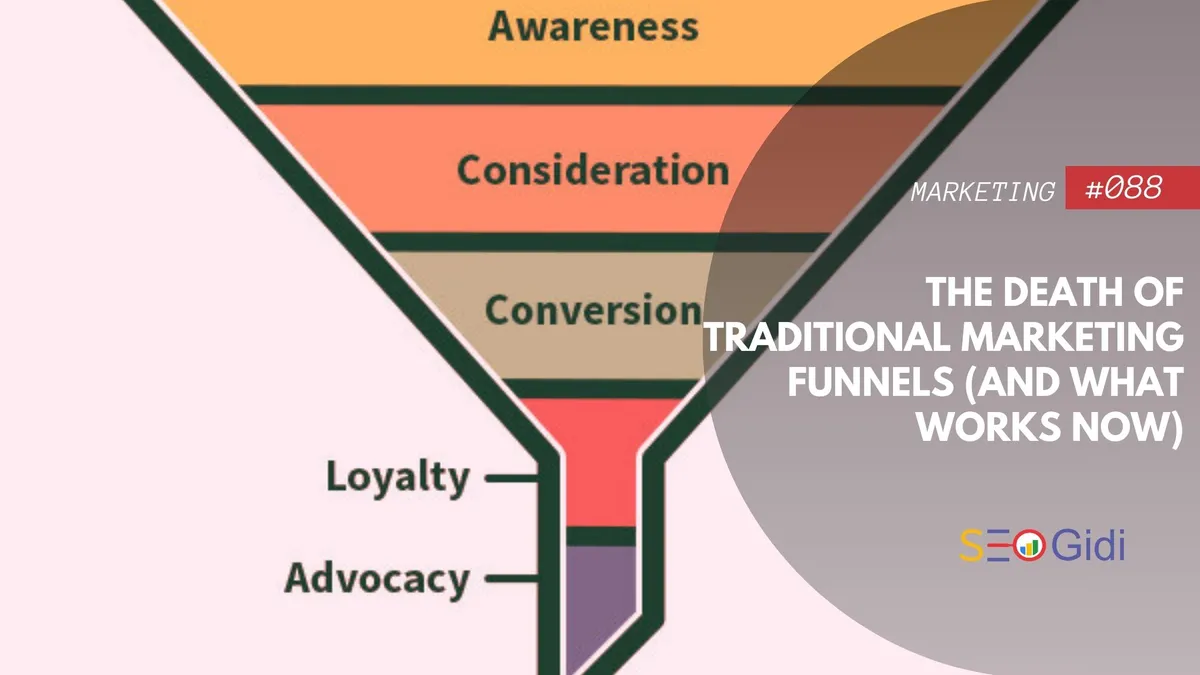
The traditional marketing funnel is dead as a description of how people buy. Awareness, Interest, Desire, Action looks neat on a slide. Real buyers do not walk it in order. They see your post on Instagram, search your reviews on Google, ask a friend in a WhatsApp group, forget you for three months, then come back because someone mentioned you on a podcast.
What works now is building for that mess instead of pretending it is a straight line. Make sure people can find you when they go looking, and keep customers close enough that they talk about you in the places you will never track. The rest of this piece explains why the funnel broke and what to put in its place.
The funnel was drawn for a time when brands controlled the route to purchase. Today the customer controls it.
Why the traditional funnel stopped working
The funnel did not die overnight. It became less useful, year after year, because buyers stopped behaving the way the textbook said they would.
Buyers move in loops, not lines
Picture a family in Lekki shopping for an inverter and solar setup. They see an installer’s video on Instagram. A week later they search “inverter installers in Lekki” on Google and read the reviews. Then someone asks in the estate WhatsApp group who installed the system at number 14.
They get two quotes, go quiet for six weeks, and finally call the installer their neighbour used. Which funnel stage was the WhatsApp group? It did the whole job on its own.
Most of the research happens where you cannot see it
Marketers call this “dark social”: WhatsApp groups, Telegram channels, DMs, Slack and Discord communities, Nairaland threads, replies on X. There is no tracking pixel in a group chat.
So your analytics will credit a sale to “direct” traffic when a voice note in a family group did the convincing. Any funnel report built only on tracked clicks is missing a large part of what actually happened.
AI answers now sit in the middle of the decision
Customers increasingly ask ChatGPT, Gemini or Google’s AI Overviews before they click anything. SEOGidi’s State of Search in Nigeria 2026 report found that 84% of online Nigerian adults used generative AI in the past year, citing Google and Ipsos fieldwork from late 2025.
The same report shows that Google still accounted for 98.3% of search-engine referrals in Nigeria in September 2026, according to StatCounter. People get shortlisted inside an AI answer, then click through from Google. Your business has to show up in both places, which is the whole idea behind generative engine optimisation. We tested what that looks like in practice when we asked AI assistants to recommend Nigerian businesses.
One post can do every stage at once
A 40-second TikTok can take someone from never having heard of you to sending a payment link request in a single sitting. The neat separation between awareness and action does not hold when the whole decision fits inside a scroll.
Funnels are not dead because marketers stopped drawing them. They are dead because customers stopped living inside them.
Funnel vs flywheel vs trust loop
The alternatives are not new triangles. They are different ways of picturing where growth comes from.
| Model | How it pictures growth | Where it helps | Where it breaks |
|---|---|---|---|
| Funnel | Push people down fixed stages until they buy | Planning ad campaigns and landing pages | Assumes order and full tracking, ignores what customers do after buying |
| Flywheel | Happy customers bring in the next customers | Businesses with a product people recommend | Spins slowly if the product or service is average |
| Trust loop | Being findable, reviewed and talked about, so each sale makes the next easier | Local businesses, services, B2B, anything bought on reputation | Takes months to build and cannot be bought in a week |
What works instead of the funnel
None of these ideas need a big budget. They need consistency and a product worth talking about.
Think in a flywheel
Growth works as a cycle: attract, engage, delight. Delighted customers create referrals, referrals create awareness, and the cycle keeps turning without a fresh ad budget each month.
A laptop repair shop in Yaba can run this with a phone. Every fixed laptop gets a WhatsApp follow-up two days later and a polite request for a Google review. The reviews lift the shop’s Google Business Profile. The profile brings in the next customer. That is a flywheel, and it costs almost nothing.
Be present where buying decisions happen
People trust people more than ads, and communities shape choices long before anyone visits a sales page. For a Nigerian business that means estate and alumni WhatsApp groups, professional circles on LinkedIn, industry Telegram channels, and the comment sections where your customers already argue.
Show up as a useful member, not a salesperson. Answer the question about which generator size fits a three-bedroom flat. People remember who helped.
Build a content system, not one-off posts
One strong blog post can become several LinkedIn posts, an X thread, a short video and a week of WhatsApp status updates. Each channel points to the others.
Search sits underneath all of it. A social post fades from the feed in a day or two. A page that answers a question people type into Google can keep bringing visitors for years. Our guide to content marketing that drives organic traffic covers how to plan that base layer.
Own your audience instead of renting it
If your whole strategy depends on ads or one platform’s algorithm, a single policy change can cut you off. An email list, a WhatsApp broadcast list and a customer database are assets you control.
We make the full case for building owned channels in No Budget for Ads? Good. Dig the Borehole Instead.
Have conversations, not just conversions
Instead of pushing people down a funnel, reply to comments, answer DMs quickly and share what you know freely. A customer who got a real answer from you at 9pm on a Sunday tells people about it.
How to plan your marketing without a funnel
You still need a plan. It just has to match how people really buy.
Meet customers where they already are
Do not force people through a fixed path. Find out where your best customers spent time before they bought from you, then be useful in those places. Ask them directly. Most will tell you.
Measure influence broadly, not perfectly
No attribution model will tell you exactly which click caused a sale. Accept that, and track signals that capture the messy middle:
- Add a “How did you hear about us?” field to your order form or ask it on the first call.
- Watch branded searches (people searching your business name) in Google Search Console. Rising branded search usually means word of mouth is working.
- Track direct traffic and WhatsApp enquiries month by month, not click by click.
- Count referrals from existing customers.
Put money into brand and trust
Performance ads bring spikes. Brand and reputation compound. Reviews, testimonials and stories from real customers keep working after the budget stops, which is the argument we make in Social Proof Is the New Currency.
Fix the basics before buying more traffic
More traffic will not rescue a weak offer or a confusing website. If people visit and leave, the problem is usually closer to home, as we explain in Why Your Marketing Isn’t Working (And It’s Not Your Ads).
Frequently asked questions
Is the marketing funnel completely dead?
As a picture of how people buy, yes. As a planning tool for a single campaign, it still has some use: you can map which ad leads to which landing page. The mistake is believing customers will follow your diagram.
What replaced the marketing funnel?
Most teams now think in flywheels or loops, where each happy customer helps bring the next one. In practice that means investing in search visibility, reviews, communities and owned channels like email, instead of only paying to push people through stages.
Should I still build landing pages and email sequences?
Yes. They are still useful tools. Just stop assuming everyone arrives at the top and moves down in order. Many visitors land on your page already half-convinced by a friend, a review or an AI answer, so the page needs to answer their real questions fast.
How do I track sales that come from WhatsApp or word of mouth?
You cannot track them perfectly. Ask every new customer how they heard about you, watch branded search in Google Search Console, and compare enquiry volume before and after activity in a community. Patterns over a few months matter more than any single number.
The funnel is dead, and marketing is messier for it. That mess is where trust gets built. If you want to see whether customers can actually find you when they go looking, start with a free SEO audit.
Sources
- State of Search in Nigeria 2026, SEOGidi, October 2026
Reports, articles and industry research, by email
Original Nigerian search data a few times a year, new guides as they are published, and a short note when Google or Meta changes something that affects businesses here. No sales emails, unsubscribe in one click.

Want this done for your business?
Get a free SEO audit: rankings, technical issues, competitor gaps and the quickest wins, within 48 hours.