seogidi.com
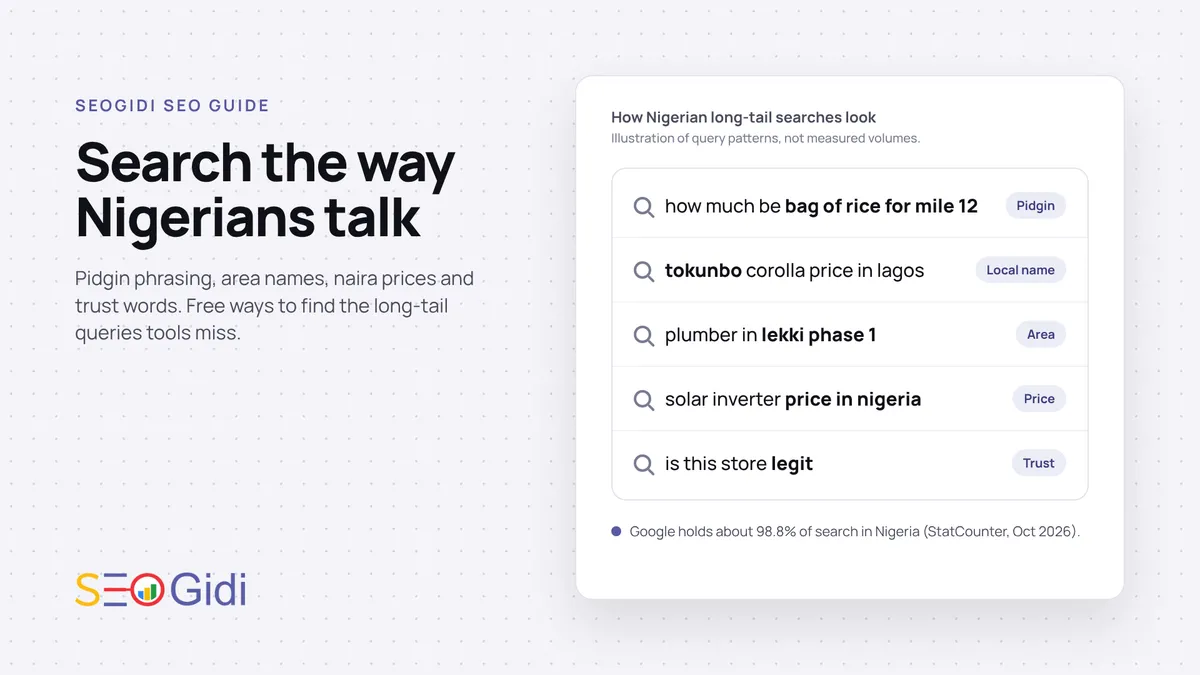
Nigerians search the way they talk. A buyer in Ikeja does not type “affordable pre-owned sedan”. She types “tokunbo corolla price in lagos”, or “where to buy original iphone charger ikeja”, or asks her phone out loud in a mix of English and Pidgin. Most keyword tools miss these phrases, which is exactly why they are worth chasing.
Local keyword research in Nigeria means collecting the exact words your customers type and speak, including local product names, area names, price words and Pidgin phrasing, from free sources such as Google autocomplete, People Also Ask, Search Console and real customer conversations. You then build pages that answer those phrases directly. This guide shows how to find them, how to judge them, and when writing in Pidgin makes sense.
Why standard keyword tools under-report Nigerian searches
Google is still where Nigerian searches happen. StatCounter puts its share of search in Nigeria at about 98.8% in October 2026. So the question is not which search engine to target. It is which words.
The tools struggle for three reasons.
First, volume. Many Nigerian long-tail phrases are likely searched only a few dozen times a month. Google Keyword Planner reports average monthly searches over a 12-month period, rounded, and counted regardless of language, and advertisers with low spend have long been shown ranges such as 100 to 1K instead of exact figures. A phrase with 40 searches a month can look like nothing.
Second, spelling. Pidgin and local words have no single standard spelling, so demand is split across variants. “Tokunbo” and “tokumbo” are counted as different keywords.
Third, privacy. Google Search Console does not show all queries, and omits rare ones to protect user privacy. The long tail you most want to see is the part most likely to be hidden.
None of this means the searches are not there. It means you have to collect them by hand.
How Nigerians search on Google: the patterns to look for
The table below lists patterns worth testing for in your own niche. The example queries are illustrations of the pattern, not measured search volumes.
| Pattern | Example query (illustration) | What it tells you |
|---|---|---|
| Mixed English and Pidgin | “how much be bag of rice for mile 12” | The searcher wants a plain, local answer, often a price |
| Local product names | “tokunbo camry 2015 abuja”, “aso ebi lace price” | Use the name customers use, not the textbook term |
| Area, not just city | “plumber in lekki phase 1”, “pharmacy wuse 2” | Build pages or sections around neighbourhoods |
| Price in naira | “solar inverter price in nigeria” | Publish real prices or ranges, dated |
| Trust words | “is [brand] legit”, “original vs fake” | Searchers fear scams. Answer with proof |
| Near me | “laundry near me”, “keke spare parts near me” | Google Business Profile and local signals do the work |
| Spelling variants | “jellof”/“jollof”, “okrika”/“okirika” | Cover the common variants naturally in copy and FAQs |
Price and trust queries deserve special attention. In a market where many sellers reply “DM for price”, a page that states prices and shows proof can rank for searches competitors refuse to answer.
Seasonality matters too, but it is a separate exercise. Seun has mapped when each trade’s searches peak in the Nigerian search calendar. This guide is about which words people use, whatever the month.
Pidgin English SEO: how much do Nigerians search in Pidgin?
Nigerian Pidgin is the most widely spoken language in Africa by one measure. Ethnologue data compiled by Visual Capitalist put it at about 121 million speakers in 2025, roughly 5 million first-language and 116 million second-language. Serious publishers write in it. BBC News Pidgin launched in August 2017 as part of the World Service’s biggest expansion in more than 70 years, and TRT Afrika runs a Pidgin news service too.
How much of that speech turns into typed searches is unknown. I could not find any public data on the share of Nigerian Google searches written in Pidgin, so treat any confident figure you see with suspicion. What you can observe for free is how Pidgin phrasing leaks into English queries: “how to”, “where to buy”, “how much is” sitting next to Pidgin words and local names.
Voice adds another layer. In March 2026, Google added Yoruba and Hausa to AI Overviews and AI Mode, bringing its AI search to 13 African languages, and users can type or speak their questions. Nigerian Pidgin was not on that list. People still speak to their phones in mixed English, and the transcript Google receives is usually English with local words inside it.
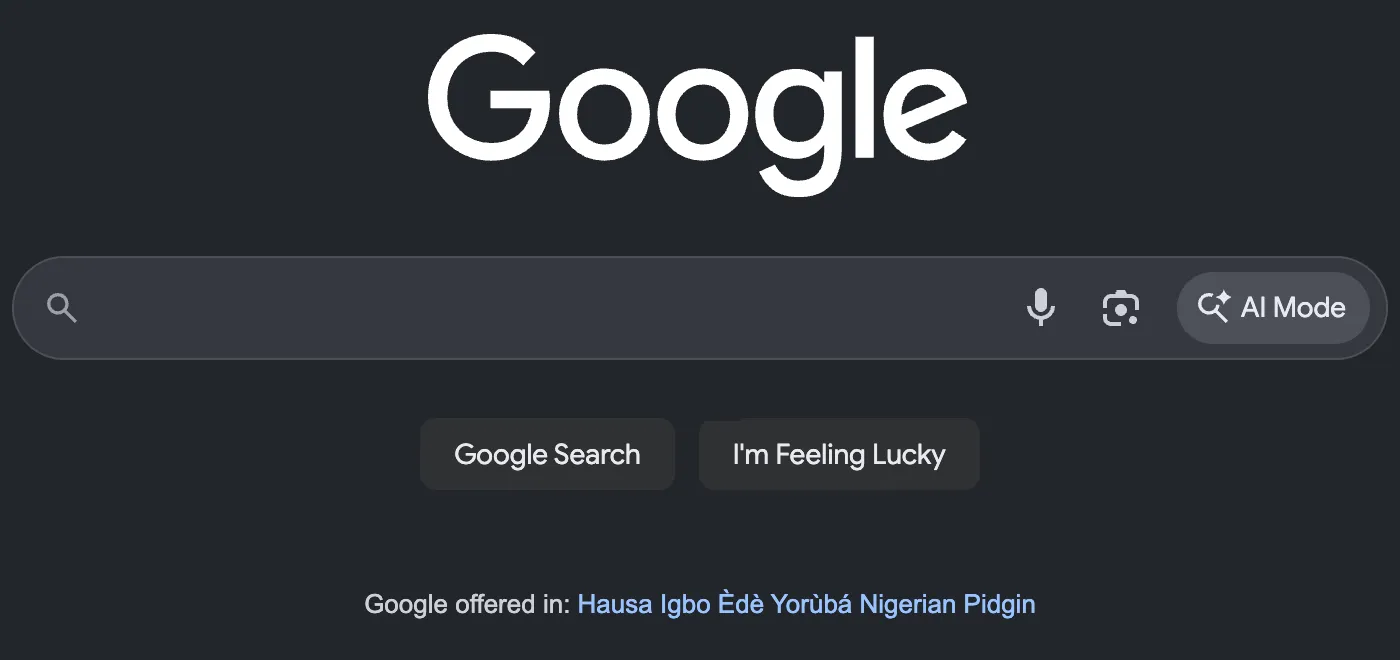
Google does already treat Pidgin as a language of Nigeria in one place: its Nigerian homepage offers the interface in Nigerian Pidgin, next to Hausa, Igbo and Yorùbá.
Where to find long-tail keywords in Nigeria for free
Google autocomplete
Google says its autocomplete predictions reflect searches that have been done on Google and take account of the searcher’s language and location. That makes it the best free window into real Nigerian phrasing.
Search from a Nigerian connection, in a private browser window, and type your seed term followed by each letter of the alphabet. Then try question starters: “how much”, “where to buy”, “how to”, “best”, “is”. Note every prediction that contains a place, a price word or a local term.
People Also Ask and related searches
Run your main terms and expand the People Also Ask box several times. Each click loads more questions. Scroll to the related searches at the bottom of the page. These show the follow-up questions Google has learnt people ask, and they are ready-made FAQ headings.
Google Search Console
If your site already gets traffic, Search Console is your most honest source, because it shows queries that actually brought impressions. Filter the Performance report by country (Nigeria), then use a regex filter such as ^(how|where|what|which|is|can) to pull question queries. Look for queries with impressions but few clicks. Those are pages Google already associates with the phrase that need a clearer answer.
Keyword Planner, used for what it is good at
Keyword Planner is still useful for grouping ideas and comparing relative demand between terms. It is weak for exact long-tail volumes in Nigeria. If you are new to it, our walkthrough on how to use Google Keyword Planner covers the setup. Treat a “0 to 10” or blank result as “unknown”, not “no demand”.
Social listening and your own customers
Your customers have already written your keyword list. Read your WhatsApp Business chats and transcribe voice notes. Scan Nairaland threads, X replies, TikTok comment sections and Jiji listing titles in your category. Write down the exact words, including the Pidgin, and the order people use them in.
A seven-step local keyword research process
- List your seed terms in customer language. Start with what customers call your product, not what your supplier calls it.
- Add every location you serve. City, then areas, then landmarks people use for directions, such as “Mile 12”, “Ojuelegba” or “Wuse 2”.
- Run autocomplete and People Also Ask for each seed. Collect everything in one sheet with the source noted.
- Pull Search Console questions. Add queries with impressions in Nigeria that you do not yet answer well.
- Add social and sales phrases. Copy exact wording from chats, voice notes and forums.
- Group by intent, not by keyword. Put “price”, “near me”, “legit” and “how to” phrases into separate groups. Each group usually needs a different page or section.
- Map each group to one page. Answer the main question in the first two sentences, cover the variants in headings and FAQs, and update prices with a date.
Local pages and a strong Google Business Profile work together. If you have not set that up, start with our guide to local SEO in Nigeria, then use this keyword list to decide what your pages and profile posts say.
When Pidgin content makes sense, and when it does not
Pidgin on a page is a brand decision as much as an SEO one. Seun covers the wider question of tone in localising product messaging for African markets. For search specifically, my judgement is this:
| Use Pidgin when | Stick to plain English when |
|---|---|
| Your audience already talks to you in Pidgin on WhatsApp and social | You sell to corporates, government or regulated buyers |
| The content is video, audio or social first | The page must win typed Google searches with clear volume in English |
| You can write it naturally, ideally with a native speaker | Nobody on the team writes Pidgin well |
| You want a section or FAQ that mirrors how customers ask | The topic involves money, health or legal risk where precision matters |
A practical middle path works for most businesses: write the page in clear English, then add Pidgin phrasing where customers use it, such as an FAQ question written the way people ask it, quotes from customers, or a short Pidgin explainer video embedded on the page.
Mistakes that waste local keyword research
- Chasing only high-volume head terms. “Shoes” is out of reach. “Men’s leather sandals price in Aba” may convert tomorrow.
- Inventing Pidgin. Forced or wrong Pidgin reads as mockery. If it does not sound like your customers, leave it out.
- Stuffing spelling variants. Mention a variant once where it reads naturally. Do not repeat every spelling in every paragraph.
- Ignoring prices. Price queries are some of the most commercial searches in Nigeria. Hiding prices hands them to competitors.
- Expecting instant rankings. Local visibility often moves in four to ten weeks. More competitive terms usually take four to eight months.
Frequently asked questions
How do Nigerians search on Google?
Mostly in English and, by StatCounter’s figures, mostly on mobile phones, with local product names, area names, naira prices and Pidgin phrasing mixed in. Many searches include trust words such as “legit” or “original”, and “near me” for local services. Autocomplete and People Also Ask from a Nigerian connection are the quickest way to see these patterns in your niche.
Should I write my website in Pidgin English?
Usually not the whole site. Write clear English pages and add Pidgin where your customers use it, such as FAQs, testimonials and video. Full Pidgin pages make sense if your audience already engages with you in Pidgin and you have someone who writes it naturally.
What is the best free keyword research tool for Nigeria?
Google Search Console, if your site already gets impressions, because it shows real queries for your pages. Google autocomplete and People Also Ask are next, because they reflect actual searches. Keyword Planner is useful for comparing ideas, but it often under-reports small Nigerian long-tail volumes.
Why does Keyword Planner show zero searches for my Nigerian keyword?
Low-volume terms are often rounded down or shown as a broad range, especially for accounts with little ad spend. Spelling variants also split demand across several keywords. Check autocomplete and Search Console before deciding a phrase has no demand.
How long does it take to rank for long-tail keywords in Nigeria?
It depends on competition and your site’s strength. Local long-tail phrases with a good Google Business Profile often start moving within four to ten weeks. Competitive commercial terms usually take four to eight months of steady work.
If you would rather have the research done for you, our SEO services start with exactly this kind of keyword map.
Reports, articles and industry research, by email
Original Nigerian search data a few times a year, new guides as they are published, and a short note when Google or Meta changes something that affects businesses here. No sales emails, unsubscribe in one click.

Want this done for your business?
Get a free SEO audit: rankings, technical issues, competitor gaps and the quickest wins, within 48 hours.