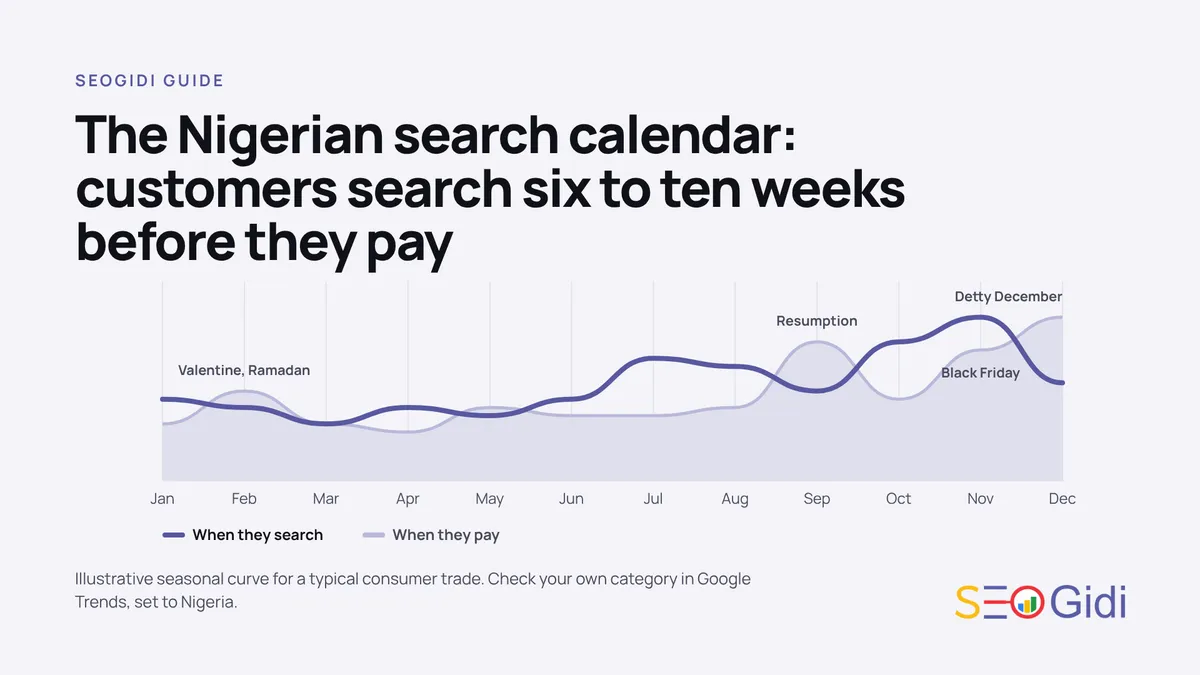
Every naira arrives twice, first as a search, then as a sale. This is the map of when the searches come.
Walk one street in Enugu in the third week of December and you will see the whole Nigerian economy doing three different things at once.
The school gate is padlocked, the compound silent, the proprietor at home doing her books and wondering how many children will return in January. Two buildings down, the hotel lobby looks like a wedding reception that never ends: IJGB accents, trolleys of luggage, a manager quoting prices he would have been ashamed of in June. And across the road, behind a door that should have closed at six, a tailor is working at two in the morning, phone buzzing with customers begging, threatening, pleading and offering double, while he promises dates he already knows are lies.
Empty, full, drowning. Three businesses, one street, one week.
Here is what twelve years of doing this work across Nigeria has taught me about that street: none of those three situations was created in December. The hotel filled in October, when a nurse in Manchester compared prices on her night shift. The tailor drowned in November, when the asoebi orders landed in one impossible fortnight. And the school’s January enrolment was being decided that same December week, by parents doing end-of-year sums at the kitchen table and quietly searching for a school whose fees will not finish them.
The money moved in December. The searching moved weeks and months earlier. That gap between when people search and when people pay is the most valuable, least mapped territory in Nigerian business.
Every business owner knows the cash calendar of their trade; your body learns it in one year. Almost nobody knows their search calendar, the earlier, invisible season when customers are quietly researching and shortlisting. So they market in the money month, which is like sowing maize in the harvest month, and then conclude that online marketing does not work.
This article is the map. The Nigerian year, season by season, as the search box sees it. Find your trade in it, and more importantly, find your dates.
First movement: January to March, the season of recovery and planning
January opens with the national hangover. Pockets are dry, and the search box fills with the vocabulary of survival: cheap, affordable, payment plan, instalment. This is a terrible month to sell luxury and a wonderful month to be the business that published honest prices and flexible terms, because the January searcher is not browsing, she is budgeting. Schools feel it hardest; fees season collides with empty wallets, and parents who never questioned a school before are suddenly comparing three. The school that spent October and November becoming findable and legible collects those defectors. January is also when the review avalanche lands: every vendor who overpromised in December gets sentenced in public, and the businesses that respond with grace in January are buying next December’s trust at a discount.
February belongs to love and to JAMB. Valentine’s drives cakes, restaurants, gifts, hotels and surprise deliveries, and its search wave starts in the last week of January, not on the 13th. Meanwhile hundreds of thousands of teenagers and their parents enter admission season: JAMB registration, past questions, CBT centres, tutorial classes. If your business touches education in any form, your content for this audience should have been live before the year turned.
And then the movable feast. Ramadan currently falls across this first stretch of the year (in 2027 it runs from roughly the second week of February to the second week of March), and because the Islamic calendar shifts earlier by about eleven days annually, the wise business re-checks the dates every single year rather than copying last year’s plan. The Ramadan economy is enormous and precise: food vendors pivot to iftar packages, tailors begin Eid orders, and the search for Eid clothes starts midway through the fast, not at its end.
Second movement: April to June, the season of rain and examinations
The rains return, and with them a whole economy nobody writes marketing plans for: roof repairs, drainage, waterproofing, generator servicing, umbrella and raincoat stock, delivery businesses explaining how they still deliver when Lekki becomes a river. The first serious downpour of April produces a spike of distress searches within hours, and the artisan who published his answers in March harvests them all.
Examination season peaks. JAMB sits its UTME, then WAEC and NECO roll through May and June, and the search box fills with anxious parents and candidates. Children’s Day in May and Democracy Day in June give event businesses their mid-year moments. The second movable feast, Ileya, the Eid of rams, currently lands in this stretch (mid-May in 2027) and shifts earlier each year like its sibling; for livestock sellers, caterers and tailors in the north and the southwest especially, it is a December-sized event hiding in the middle of the year.
June also begins the quiet accumulation that amateurs miss: the first wedding enquiries for December start now, from the most organised brides and from abroad. The vendor who thinks December business starts in December has already lost the best customers by the rains.
Third movement: July to September, the season of holidays and the great resumption
Schools pour out in July, and parents immediately face the oldest equation: children at home multiplied by working parents equals searches for summer lessons, coding classes, holiday camps, football academies, anything structured. Travel moves too; the diaspora comes home for summer weddings, and August, the strange dry window inside the rainy season, hosts more owambe than its reputation admits.
Then September arrives, and with it the single most predictable, most valuable search storm in the Nigerian year: resumption. New session, new schools, new uniforms, books, shoes, bags, hostels, school buses. Parents change schools in September more than in any other month, which means the enrolment battle for September is fought with content published in June and July. Every education business, and every business that sells anything a child wears or carries, should treat the first week of September the way retailers treat Black Friday, and should be fully visible by mid-July.
September has a second, quieter identity, and regular readers of this series already know it: it is when December begins. The nurse in Manchester, the engineer in Houston, the bride with a December date, all start their searching now. Hotels, shortlets, caterers, planners, photographers, car hire, tailors: your December harvest is sown in September, a case I made in full in the December diaspora playbook.
Fourth movement: October to December, the season of the crescendo
October opens with Independence Day and closes with the harmattan creeping in, bringing its own small economies: skincare searches turn to lip balm and lotion, car owners fight dust, and the inverter and generator conversations sharpen ahead of festive-season light. Convocations scatter across the quarter, filling hotels in university towns on dates every local vendor should keep pinned. And the December search wave, a trickle in September, becomes a river: flights, hotels, asoebi, hall bookings, pre-orders.
November is the most commercially intense search month of the Nigerian year. Black Friday has become a national event, and its searches begin in the first week of the month, with shoppers hunting deals, comparing, and asking the eternal Nigerian question: is this discount real? Vendors who publish their actual Black Friday offers early, with real prices, collect buyers who have been burned by fake slashes. Meanwhile the December books are closing: serious caterers and photographers are declining dates by mid-November, and the smart ones announce it, because “fully booked”, screenshotted, is next year’s advertising.
December itself, for the search calendar, is a month of last-minute desperation and next-year beginnings. The searches that convert now contain the words available, same day and last minute, and the vendor with visible availability eats alone. And even while the parties run, January’s searches are already starting: school fees, cheap, new year, gym. The wheel does not pause.
How to build your own calendar from this map
The method is one sentence: find your money months, then publish six to ten weeks before each one, because that is when your customer starts searching and because content needs time to rank before the wave, as I explained in the content system for Nigerian entrepreneurs.
Do it on paper tonight. Write your three biggest money months. For each one, count backward six to ten weeks and circle that date; that is a publishing deadline, not a suggestion. Then verify my map against your own trade with two free tools. Google Trends, set to Nigeria and to the past five years, will show you exactly when searches for your product rise and fall across the year. Google’s own autocomplete, checked in each season, tells you the words your customers use when the wave comes. Your trade may have seasons this map does not show: the conference season of Abuja hotels, the fishing calendar of a riverine town, the strange mid-year spike only your industry understands. Map them. A business that knows its search calendar stops marketing in panic and starts marketing in ambush.
For quick reference, the year at a glance:
| Months | The money | The searching you must already have answered | Publish by |
|---|---|---|---|
| Jan to Mar | School fees, Valentine’s, Ramadan trade | Affordable everything, admission season, Eid orders | Mid-November |
| Apr to Jun | Rainy-season repairs, exams, Ileya | Distress fixes, tutorial classes, early December weddings | Mid-February |
| Jul to Sep | Summer lessons, resumption | Holiday camps by June, school choices by July, December by September | Mid-May |
| Oct to Dec | Black Friday, Detty December | Real deals in early November, availability and last minute in December | Mid-August |
The “publish by” column is the six-to-ten-week rule applied to the start of each season. If your money month sits late in a season, push the deadline later by the same amount; the gap is what matters, not the calendar quarter.
The street in Enugu, one year later
Go back to that street next December and imagine the three businesses had this map.
The school spent October being findable, published its fees beside a payment plan, and answered the midnight parents while rivals slept; its January gates will open to fuller classrooms. The hotel met the Manchester nurse in September with prices, photos, honest availability and a WhatsApp that answered across time zones, and filled at better rates, earlier, with less desperation. The tailor took his December orders in October with deposits and a closed book by mid-November, slept at night, delivered everything, and his January reviews read like love letters.
Same street. Same December. Different year entirely, and the only thing that changed is that three business owners learned to read the season before the season.
The money will come when it always comes. The question this article leaves you with is simpler and sharper: when your customers start searching, weeks before their money moves, will the answer they find be you?
Check your calendar. For most trades reading this, the next deadline is closer than it looks. If you would rather have the dates worked out for your trade and your city, the free SEO audit includes a seasonal search check: we pull your category’s Nigerian search curve and hand you the publishing deadlines.
Reports, articles and industry research, by email
Original Nigerian search data a few times a year, new guides as they are published, and a short note when Google or Meta changes something that affects businesses here. No sales emails, unsubscribe in one click.
Set SEOGidi as preferred source
Want this done for your business?
Get a free SEO audit: rankings, technical issues, competitor gaps and the quickest wins, within 48 hours.