seogidi.com
In 2023 a dealer on the Kubwa Expressway could put ten cars on the lot with ₦50 million. The same money buys three today, and each of the three takes longer to sell than the ten did.
That is the Abuja car business in one sentence. A 2005 Corolla that cost ₦1.5 million three years ago now lists at ₦8 million to ₦8.5 million imported, and ₦4.3 million to ₦4.5 million Nigerian-used. A 2010 Camry has gone from under ₦3 million to ₦9 million or ₦10 million. Dealers told Legit.ng in October that some of them go three or four months without a sale. The buyer who used to walk onto a stand in Karu with ₦2 million in cash and drive out the same afternoon has not disappeared. He has become a buyer with ₦9 million who spends three weeks on his phone before he visits anyone.
This article is about those three weeks, and how an Abuja dealer gets into them.
The buyer did not leave. The buying changed.
Three things happened at once, and together they rewrote how cars are bought in the capital.
Prices moved out of impulse range. When a car costs a year of a civil servant’s salary, nobody buys it the way they buy a phone. They search the model and the year, read what it should cost, compare three or four sellers, check who has complained about whom, and only then send a WhatsApp message. Our automotive clients see the same pattern across Nigeria: the research period before a car purchase now runs for weeks, and the dealer who appears throughout it is the one who gets the call.
Tokunbo buyers became Nigerian-used buyers. Import duty on used vehicles dropped from 15% to 5% in July 2026 and the Green Tax exempts anything under 2,000cc, but the naira did more damage than the duty cut repaired. Punch reported in 2025 that owners were selling private cars to cover living costs and that demand had shifted to locally used vehicles, with Cotonou buyers now crossing into Nigeria for bargains, a reversal of the old route. In Abuja this means the “Tokunbo Camry” search is now often a “Nigerian used Camry” search, and the buyer is more nervous, because a locally used car has a history nobody wrote down.
The search moved to the phone, and partly to AI. Three quarters of Nigerian web traffic is on mobile, and Google now carries 98% of search referrals. Our State of Search in Nigeria 2026 report found that 84% of online Nigerians used generative AI last year, and when we asked ChatGPT where to get cheap cars in Osogbo, it named three dealers with landmark addresses and phone numbers read straight off their Google Business Profiles. The dealer with no profile was not in the answer.
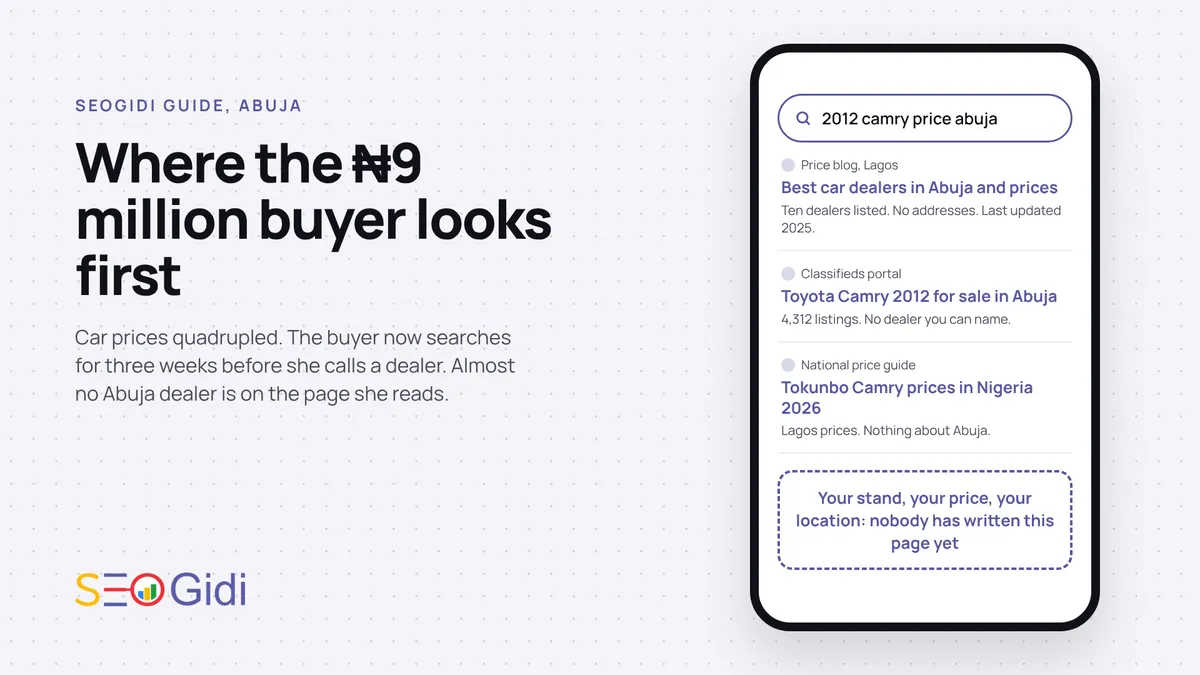
Put those together and the question for an Abuja dealer is no longer “how do I get more people to the stand”. It is “when a buyer in Gwarinpa types 2012 Camry price Abuja at eleven at night, what does she find, and is it me?”
What she finds today
We ran the searches. Here is what sits on page one for the money terms in Abuja, and what it tells you about the opening.
For “car dealers in Abuja”, the top results are listicles. One names ten dealers with price ranges and not a single address; a reader asked in the comments where the dealers are and nobody answered. The others are classifieds portals, Cars.ng and Jiji and Autochek, with thousands of listings and no dealer you could call by name. For “Tokunbo Camry price Abuja” and “Nigerian used Corolla Abuja”, the results are national price guides from Lagos blogs, updated when the writer remembers.
Notice what is missing. No dealer’s own site ranks for any of it. No page says “here is what a clean 2010 Camry costs in Abuja this month, here are four on my lot, here is my number and here is where I am on the Kubwa Expressway”. The buyer wants exactly that page, Google has nothing to show her, and the first Abuja dealer who writes it will own the search for a long time.
That is the opening. The rest of this article is how to take it.
Step one: fix the thing the buyer checks first
Before a buyer looks at your cars she looks at you. On a phone that means your Google Business Profile: the panel with your name, your stand’s location, your hours, your photos and your reviews. It is the single most-cited source when AI assistants answer local questions, and in Google Maps it is the whole result.
Most Abuja dealers we audit have one of three problems. The profile does not exist, so the stand shows up as a grey pin somebody else dropped. The profile exists under a cousin’s name with a number that stopped working in 2022. Or the profile exists and is fine, with four photos from 2021 and eleven reviews, one of them a complaint about a gearbox nobody replied to.
Fix it this week:
- Claim it, and set the category to “Used car dealer” (or “Car dealer” if you sell new). Put the stand’s actual location, not the office in Wuse 2 where nobody can see a car.
- Add twenty photos: the lot, the signboard, the entrance from the road, the current stock, the people. Buyers want to see that the place is real before they drive to Zuba.
- Answer every review, including the gearbox one. A reply that says what you did about it reads better than a 4.9 with no replies.
- Post the stock. Business Profile posts are free and most dealers never use them. “2012 Camry XLE, Nigerian used, first body, ₦9.2m, on the lot today” with three photos is a post that gets clicked.
Our guide to local SEO in Nigeria covers the rest of the profile work. For a dealer, the profile is half the battle, because a lot of car searches end on the map without ever reaching a website.
Step two: give the buyer the page she is searching for
The other half is the website, and here is where the Abuja car trade has a strange blind spot. Dealers who will spend ₦400,000 on a Jiji boost and ₦150,000 a month on Instagram ads do not have a page on the internet that they own. Every car they list belongs to Jiji’s search results, not theirs. When the listing expires, so does the trace of them ever having sold it.
A dealer site does not need to be large. It needs four things, and each one maps to a search a buyer is already making.
A stock page that is current. Every car on the lot, with real photos, the year, the mileage, Tokunbo or Nigerian used, the price, and a WhatsApp button that opens with the car’s name in the message. Price on the page. The buyer who has to DM to find out the price has already assumed you are hiding something.
A price guide for your city. One page, updated monthly: “Used car prices in Abuja, November 2026”, with what the ten most-searched models are going for on your lot and in the market. Corolla 2005 to 2010, Camry 2007 to 2014, Honda Accord, CR-V, RAV4, Highlander, Hilux, Lexus RX, Golf, Sienna. This is the page that ranks for “Camry price Abuja”, and it is the page every buyer reads before she calls anyone. Nobody in Abuja has written it.
A page per area you serve. Not spam, a real page: “Car dealers in Kubwa: what to check before you buy, and what we have”, with the stand’s location, how to get there, and the stock nearest that buyer. Gwarinpa, Kubwa, Lugbe, Karu, Zuba, Garki. The buyer searches her own area first.
A page that answers the fear. Nigerian-used buyers are afraid of accident cars, flood cars, faked mileage and customs papers that will not survive a checkpoint. A page called “How we check every Nigerian-used car before it goes on the lot” with the actual inspection list, the VIN check, the customs paper check and the test drive policy is both the most reassuring thing on your site and the one most likely to earn a link from a blog writing about buying cars safely.
That is a five-page site. The website build we offer is this exact structure for ₦200,000, with the stock page editable from your phone, which matters because a stock page that is three weeks stale is worse than none.
Step three: be the dealer people mention
Here is the part most dealers skip, and it is the part that decides who ranks when two dealers have both done steps one and two.
Google and the AI assistants trust a business that other people talk about. In the Ahrefs study we charted in the State of Search report, being mentioned by name across the web predicted AI visibility three times better than backlinks did. For an Abuja dealer that means three things:
- Get into the roundups. The listicles that rank for “car dealers in Abuja” are weak, and the people who write them answer emails. Write to each one with your address, your stock photos and a line about your inspection policy, and ask to be included. Being named in three of those pages, with your location, is worth more than a month of boosted posts.
- Be quotable. Nairametrics, Legit, Punch and BusinessDay write about car prices every month and they quote dealers. The ones quoted are the ones who answer the phone and give a number. Say yes, give the Corolla price, and your name goes into the article that ranks nationally. Reporters keep a list of dealers who reply; be on it.
- Publish what you know. You know which 2010 Camry trim holds value, which Honda year has the transmission problem, what the customs paper for a Cotonou car should look like. Write it, once a month, on your own site. That is what makes a blog cite you, and what makes an AI assistant describe you as “known for” something.
The dealer who does this becomes the one the city’s writers call, and the one the machines name. We call it the mention economy, and it is the difference between a stand that is found and a stand that is driven past.
What this looks like in ninety days
A realistic plan for a dealer with a stand and a phone, no marketing staff:
Weeks 1 to 2. Business Profile claimed, correct location, twenty photos, every review answered, first stock post. Site live with the four pages above, stock loaded, WhatsApp on every car.
Weeks 3 to 6. First “Used car prices in Abuja” guide published and sent to the three ranking listicles with a request to be added. Area pages for the two districts your buyers actually come from. Indexed in Search Console; the profile linked to the site with matching name, address and phone.
Weeks 7 to 12. Price guide updated for the month. One “what to check” article. Two reporters replied to. Reviews asked for at every delivery, with a link, because twenty detailed reviews puts an Abuja dealer in the top tier of its category.
What you should expect: map visibility for your area terms inside a month, because almost nobody is competing properly; the price guide ranking for model-plus-Abuja searches within two to three months, because nobody has written one; enquiries that arrive already knowing the price and the location, which are the ones that close. What nobody can promise is a position for “car dealers in Abuja” on a date, and anyone who does is selling you a Jiji boost with a different name.
The ₦8 million buyer is still out there
Dealers tell reporters sales have collapsed. What has collapsed is the walk-in. The buyer with ₦9 million exists; she is just doing on her phone what she used to do on the lot, and most Abuja dealers are invisible to her for the entire three weeks it takes her to decide.
The stand that fixes its profile, puts its prices on a page it owns, and becomes the name people mention is not competing with the whole city. It is competing with nobody, because nobody else has done it yet.
If you want to see where your stand sits today, the free SEO audit now includes an AI visibility check: we search your area and your models the way a buyer does, and tell you who comes up instead of you. If you would rather hand the whole thing over, automotive SEO is a service we run for dealers and auto businesses across Nigeria.
Reports, articles and industry research, by email
Original Nigerian search data a few times a year, new guides as they are published, and a short note when Google or Meta changes something that affects businesses here. No sales emails, unsubscribe in one click.
 Set SEOGidi as preferred source
Want this done for your business?
Get a free SEO audit: rankings, technical issues, competitor gaps and the quickest wins, within 48 hours.