seogidi.com
For three years, every business that wondered whether ChatGPT was sending it customers has had to guess. You could see a trickle of visits from chatgpt.com in your analytics, you could pay a third-party tool to run prompts and count how often your name came up, or you could ask a customer how they found you and hope they remembered. None of it was first-party data from OpenAI.
That is about to change. OpenAI is testing a dashboard inside ChatGPT that shows a verified business how many times it appeared in ChatGPT answers and how many clicks those answers sent to its website, day by day, on a chart. People on LinkedIn are calling it the ChatGPT Search Console, and the comparison is fair. It is also incomplete, and the gaps matter as much as the headline.
This article sets out what has been seen, what has not, how it compares with what Google and Bing already give you, why OpenAI is building it, and what a business in Lagos or Nairobi should do before it arrives.
What has actually been seen
The feature was spotted by Juozas Kaziukėnas, an e-commerce analyst who had been noticing pieces of it since August, and reported by Barry Schwartz at Search Engine Roundtable on 6 November 2026. OpenAI has not announced it or commented. Everything below comes from screenshots and the flow Kaziukėnas walked through, so treat it as a preview, not a spec.
The dashboard sits inside a larger feature called the Business Hub, under a flow labelled “Claim your business in ChatGPT”. The hub has three parts:
- Visibility. How often your business is mentioned in ChatGPT conversations, shown as two metrics, impressions (the number of times your business appeared in a response) and clicks (clicks on links to your website), tracked daily and charted over time.
- Business information. A place to keep your details current and add your latest products, so the model has something accurate to work from.
- Customer decisions. A “business agent” that can answer customer questions inside ChatGPT, with context you control.
Access is limited to businesses that verify ownership. The one verification route visible so far is connecting a Shopify store. There was a banner in the interface suggesting the feature is close to launch, but no date.
What it will not tell you
Kaziukėnas was direct about the limits, and they are the most important part of the story. The dashboard shows no prompt data, no user data, and no competitor benchmarks or rankings. You will see that mentions rose or fell. You will not see which questions produced them, who asked, or whether a competitor took the mention you lost.
In his words, “it won’t help understanding why mentions/clicks are increasing or decreasing”.
That is a meaningful difference from Google Search Console, which has shown queries since 2010. A rising line with no queries behind it is a scoreboard, not a diagnostic. It tells you whether the work is paying off; it does not tell you what the work should be. For that you will still need the manual method we used in our own test of what ChatGPT recommends in Nigeria: ask the questions your customers ask, in the way they ask them, and read what comes back.
How it compares with Google and Bing
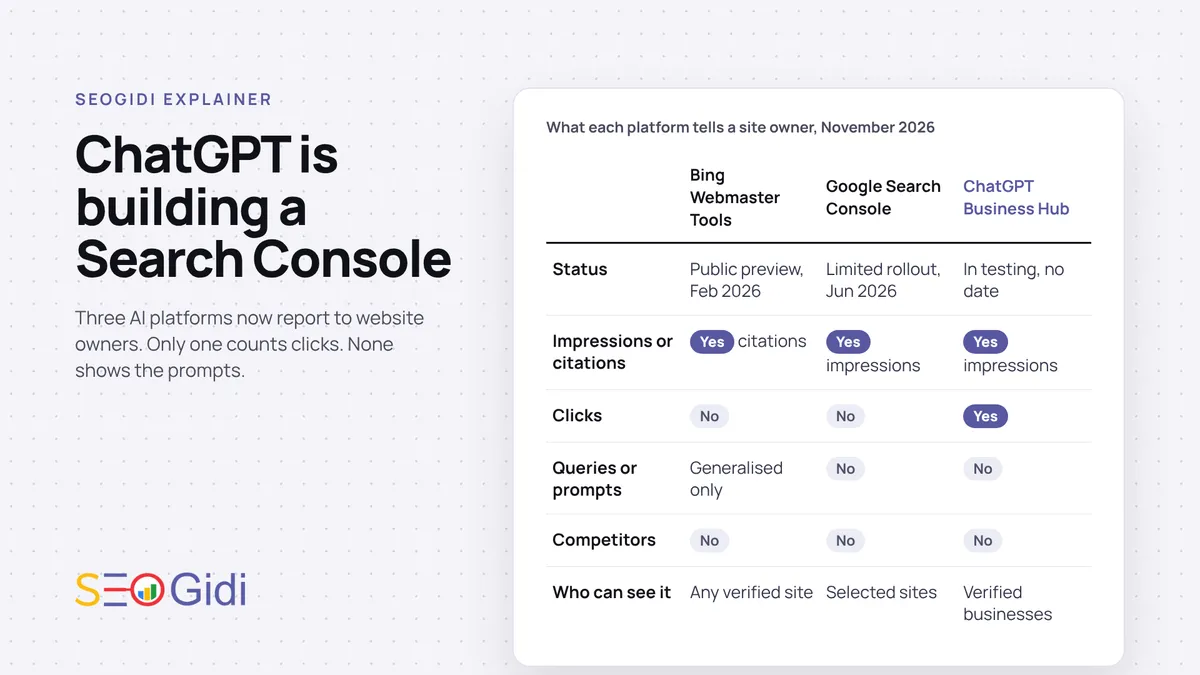
ChatGPT is the third platform to offer this kind of report in 2026, and the three are not the same.
| Bing Webmaster Tools | Google Search Console | ChatGPT Business Hub | |
|---|---|---|---|
| Launched | February 2026, public preview | June 2026, limited rollout | In testing, no date |
| Surfaces | Copilot and Bing AI answers | AI Overviews, AI Mode, Discover | ChatGPT responses |
| Shows | Citations, cited pages, grounding queries | Impressions by page, country, device | Impressions and clicks |
| Clicks | No | No | Yes |
| Queries or prompts | Generalised grounding queries | No | No |
| Who can see it | Any verified site | A subset of sites so far | Verified businesses only |
Two things stand out. First, ChatGPT is the only one of the three that reports clicks. Bing’s report counts citations and says plainly that it is not about clicks or rankings. Google’s report counts impressions in AI Overviews and AI Mode and leaves clicks out. OpenAI choosing to show clicks is a decision to prove that ChatGPT sends traffic, which is a claim publishers have doubted for two years.
Second, Bing is the only one that shows anything resembling a query, and even that is generalised. The industry has spent a decade on query-level data, and the AI platforms are, so far, declining to provide it.
Why OpenAI is building it
The charitable reading is that businesses asked for it. The commercial reading is in OpenAI’s own numbers. ChatGPT ads went live for free users in the United States in February 2026, a self-serve ads manager followed in May, and on 31 August OpenAI said the ad business had passed a $1 billion annualised run rate, roughly 200 days after launch.
Google Search Console was never a charity either. It gives you free organic data, and the gap between what you rank for and what you wish you ranked for is filled by Google Ads. A free ChatGPT dashboard that shows a business its impressions and clicks, next to an ads manager that sells more of both, follows the same pattern. Aaron Heienickle made the same argument the day the news broke, and nothing in the screenshots contradicts it. Search Engine Roundtable notes the analytics appear to measure organic responses, separate from ads, which is exactly how Search Console relates to Google Ads.
The Shopify verification route points the same way. A business that connects its store hands OpenAI a structured catalogue with prices, availability and images, which is what ChatGPT’s shopping answers need. The dashboard is the incentive to connect; the catalogue is the prize.
None of this makes the tool less useful. It does mean you should read it as a channel owner’s report on its own channel, the way you read Meta’s or Google’s.
The Nigerian view
The buzz on LinkedIn is mostly American and European. Here is what the same news means for a business in Nigeria or elsewhere in Africa.
The audience is already here. Our State of Search in Nigeria 2026 report found that 84% of online Nigerians used a generative AI tool in the past year, among the highest rates in the world. Across the trackable AI referral market, ChatGPT accounts for about 92% of visits, according to Previsible’s July study. If AI assistants send your site any traffic at all, almost all of it is ChatGPT, and this dashboard is the first place that traffic will be counted by the source.
The traffic is real and small, and it is growing fast. Across nearly 75,000 sites in March 2026, Ahrefs measured AI chatbots at 0.28% of all visits. For most businesses that is a handful of sessions a month, easy to miss inside the Referral bucket. A research publisher like us sees more, and a dentist in Lekki will see less. But the share is climbing, and the dashboard will make it visible to businesses that have never checked.
Verification may be the hard part. Most Nigerian businesses do not run on Shopify. If connecting a Shopify store stays the main verification route at launch, a large share of African businesses will be locked out of the dashboard on day one. OpenAI will almost certainly add other routes, as Google did with DNS and HTML-file verification, but “almost certainly” is not a date. Businesses with a Shopify store, or with the budget to put their catalogue on one, will see their numbers first.
The business agent is the quiet part. A ChatGPT agent that answers customer questions with context you control is a WhatsApp-style support line inside the assistant Nigerians already use. For a hospital or a school it is also a liability if the context is thin or stale. Whoever maintains your business information in the hub will be doing something closer to customer service than to marketing.
What to do this week
The dashboard does not exist yet for you. These do.
- Record your baseline. In Google Analytics 4, open Traffic acquisition, filter by session source containing
chatgpt.com, and note the last 90 days. The moment the dashboard launches, you will want a before. If you have no referrals at all, that is also worth knowing. - Build an AI channel. The default GA4 channel grouping files ChatGPT under Referral, next to every blog that links to you. Create a custom channel group with a rule for sources matching
chatgpt.com,perplexity.ai,claude.ai,gemini.google.com,copilot.microsoft.com,meta.aiand the rest, and call it AI Assistants. Until you do, AI visits are spread across Referral and you cannot see the trend. - Switch on the reports you already have. Bing Webmaster Tools’ AI Performance report is open to any verified site today and takes ten minutes to set up. If Google’s generative AI report has reached your Search Console property, read it. Neither shows clicks, but both show whether you are being cited at all.
- Fix the pages ChatGPT lands on. After a May update, Similarweb found the share of ChatGPT referrals landing on homepages rose from about 25% to nearly 60%. Your homepage is now the page most AI visitors see first. If it does not say what you do, where you are and what it costs in the first screen, you are losing the visit the assistant just sent you.
- Make your business information consistent. The hub will ask for the same facts every other platform asks for: name, address, phone, hours, products, prices. If your Google Business Profile, your website footer and your Instagram bio disagree, decide now which is right. Our guide to getting a Nigerian business mentioned by ChatGPT covers what the assistants read and in what order.
- Keep a manual prompt log. Since the dashboard will not show prompts, keep your own. Ten questions your customers ask, run monthly in ChatGPT, with the answers saved. It is the only way you will know why the line on the chart moved.
What we do not know
It is worth being plain about the open questions, because a lot of the commentary is filling them in with confidence it has not earned.
We do not know the launch date, or whether it will be global on day one. We do not know whether it will be free, or free for a while. We do not know whether verification routes beyond Shopify will exist at launch. We do not know how “impression” is defined: whether a business named in passing counts the same as one recommended with a link, or whether appearing in a response that was never read counts at all. We do not know whether the clicks figure will match what your analytics records, and the history of every other platform’s reporting suggests it will not.
What we do know is that the largest AI assistant in the world is about to tell businesses, in numbers, how often it mentions them. For most Nigerian businesses that number will be small. The ones who see it first will be the ones who can do something about it, and the work that moves it is the same work that has always moved search: be described clearly and consistently everywhere you appear, and be mentioned by the people and pages the model trusts. That part did not change this week.
If you want to know where you stand before the dashboard tells you, the free SEO audit includes an AI visibility check: we ask ChatGPT, Gemini and Google’s AI Mode the questions your customers ask, and tell you who comes up and why.
Sources
- Barry Schwartz, OpenAI Working On ChatGPT Tools For Business For Analytics & Citations, Search Engine Roundtable, 6 November 2026
- Juozas Kaziukėnas, original LinkedIn post with screenshots
- Aaron Heienickle, ChatGPT Is Building Its Own Search Console (and It’s Really About Ads), 6 November 2026
- Google Search Console generative AI performance reports, PPC Land on the Search Central announcement, June 2026
- Bing Webmaster Tools AI Performance reporting, Koozai, February 2026
- OpenAI ad business reaches $1 billion annualised run rate, SiliconANGLE, 31 August 2026
- SEOGidi, State of Search in Nigeria 2026 and We asked ChatGPT and Gemini to recommend Nigerian businesses
Reports, articles and industry research, by email
Original Nigerian search data a few times a year, new guides as they are published, and a short note when Google or Meta changes something that affects businesses here. No sales emails, unsubscribe in one click.

Want this done for your business?
Get a free SEO audit: rankings, technical issues, competitor gaps and the quickest wins, within 48 hours.