seogidi.com
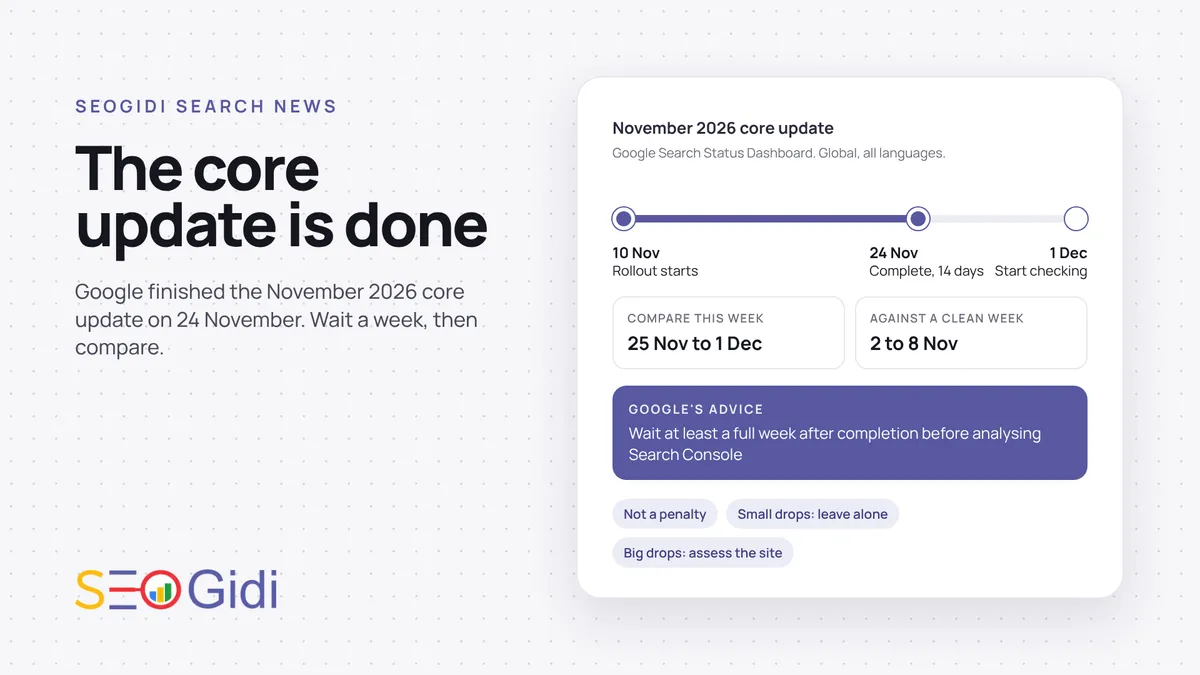
Google’s November 2026 core update has finished rolling out. Google’s Search Status Dashboard marked it complete at 06:03 Pacific time on 24 November 2026, which is 15:03 in Lagos. It started on 10 November, so the rollout took 14 days, inside the “up to 2 weeks” Google gave at launch.
If your rankings moved in the last fortnight, this is the most likely reason. The rest of this post covers what Google said, what we saw on seogidi.com during the rollout, and what to do now.
What Google said
Google’s announcement was short. The update “applies globally and to all languages”, according to the dashboard, and Google described it as “a regular update designed to better surface relevant, satisfying content for searchers from all types of sites”, as Search Engine Roundtable reported on launch day. There was no blog post listing specific changes.
That wording matters. A core update is not a penalty and does not target one tactic. Google reassesses which pages best answer each search, so some pages rise and others fall without anything being “wrong” with them.
| November 2026 core update | |
|---|---|
| Started | 10 November 2026, 10:06 Pacific |
| Completed | 24 November 2026, 06:03 Pacific |
| Length | 14 days |
| Scope | All countries, all languages |
| Google’s stated aim | Surface relevant, satisfying content from all types of sites |
Two data traps to watch
Before you read your own numbers, watch for two things that can mislead you.
Search Console’s generative AI report undercounted 9 to 11 November. Google confirmed that “a logging error caused a decrease in impressions on the Generative AI performance report in Search”, and that it “affects data logging only”, according to Search Engine Roundtable. If your AI Overviews impressions dipped on those days, that is the bug, not the update.
Rank trackers can have gaps. Third-party tools depend on collecting Google results, and collection sometimes fails. If your tool shows a sudden one-day crash, check whether the missing data was recorded as “not ranking” before you act on it. Search Console is the better source for your own site.
What we saw on our own site
We watched seogidi.com in Search Console through the rollout. Both weeks below sit inside the update, so read them as movement, not a final result.
| Search Console, 16 to 22 Nov against 9 to 15 Nov | Week 2 | Week 1 |
|---|---|---|
| Clicks | 65 | 35 |
| Impressions | 2,840 | 4,030 |
| Average position for “seo company nigeria” | 27.2 | 7.6 |
| Average position for “best seo company in nigeria” | 40.8 | 18.8 |
| Impressions for “seo company in lagos” | 58 | 375 |
Clicks rose, mostly from people searching for our brand, while some of our most valuable Nigerian searches fell sharply. That is a typical core update pattern: a site can gain and lose in the same week, on different queries. We are not changing those pages in a panic. We are improving them, which is what Google’s own guidance recommends, and we will report the settled numbers here once a full week has passed.
What to do now
- Wait a full week before judging. Google’s core update guidance says to wait “at least a full week after a core update completes before analyzing your site in Search Console”. For this update, that means checking from 1 December 2026.
- Compare the right weeks. Compare 25 November to 1 December against a week before the rollout began. We are using 2 to 8 November, which also avoids the generative AI logging error.
- Look at queries and pages, not just the total. In Search Console, open Performance, set the comparison, and sort by the difference in clicks. A total that looks flat can hide one page that fell and another that rose.
- Leave small drops alone. Google says that for a small drop in position “there’s no need to take drastic action”, and recommends avoiding changes to content that is already performing well.
- For a large, lasting drop, assess the whole site. Google asks you to check whether “your site overall (not just individual pages) is delivering content that’s helpful, reliable, and people first.” Its helpful content questions are the place to start, and it suggests asking someone unconnected to the site to answer them.
- Improve, then be patient. Recovery can show up with smaller, unannounced updates, but Google says that if months pass without change, it “could mean waiting until the next core update”. There is no guarantee either way.
If a top page fell, our guide on what to do when your top pages drop in Google rankings walks through the checks page by page. If AI Overviews matter to you, read it alongside our guide to the Search Console generative AI report.
What it means for Nigerian businesses
Core updates apply to every country at once, so Nigerian sites compete in the same reassessment as everyone else. Pages that win tend to answer the searcher’s question fully and show who is behind them: real prices in naira, a named expert, an address and evidence. Thin location pages and service pages that say the same thing as every competitor are the ones most likely to slip.
If your rankings dropped and you want a second opinion before you change anything, start with a free SEO audit. We will tell you whether it looks like the update, a technical problem or a competitor, and what to fix first.
Reports, articles and industry research, by email
Original Nigerian search data a few times a year, new guides as they are published, and a short note when Google or Meta changes something that affects businesses here. No sales emails, unsubscribe in one click.

Want this done for your business?
Get a free SEO audit: rankings, technical issues, competitor gaps and the quickest wins, within 48 hours.