seogidi.com
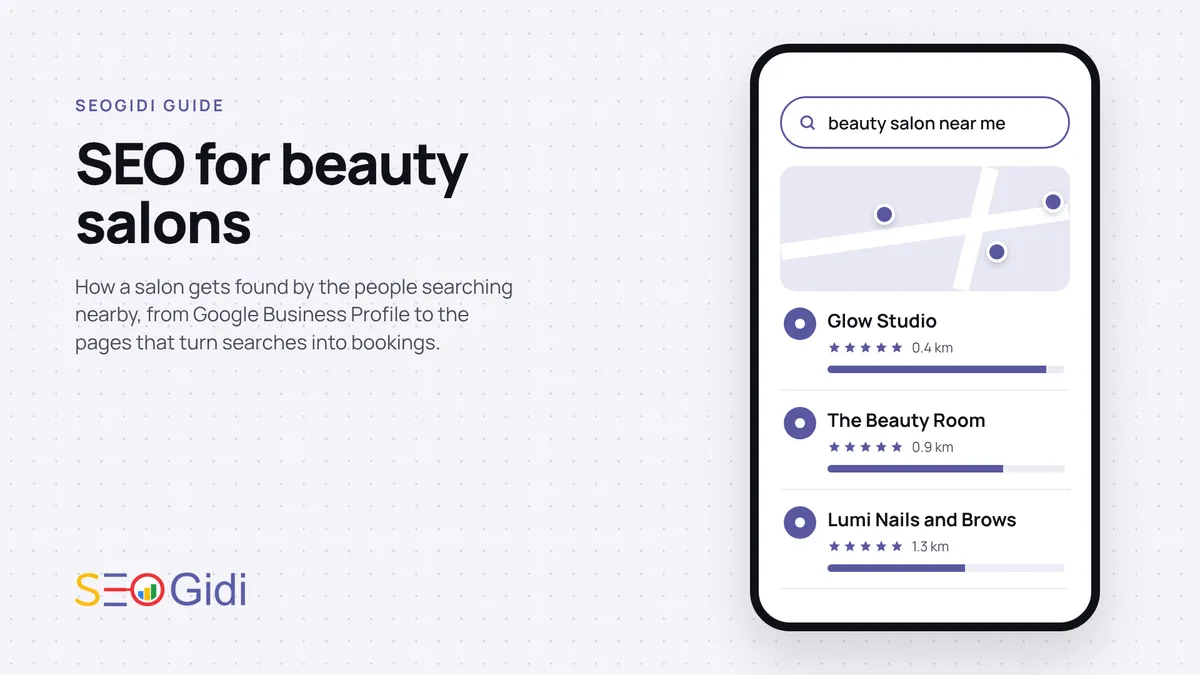
SEO for a UK beauty salon comes down to two places: the Google map results for “beauty salon near me” and similar searches, and a website with one clear page per treatment. Get your Google Business Profile complete and active, earn a steady flow of reviews, and build pages for the treatments people book (“lash lift in Leeds”, “HydraFacial Clapham”). That combination wins most of the local bookings that come from search.
The rest of this guide is the detail: which keywords to target, how to set up each page, what to do on your profile, and how to measure whether any of it is bringing people through the door.
Why search matters more than Instagram for bookings
Instagram is where people admire your work. Search is where they decide to book. Someone typing “gel nails near me” on a Thursday evening wants an appointment this weekend, and the three salons in the map pack get most of the calls.
Social media still helps. It gives people a reason to remember your name and search for it later. But a salon that depends only on its feed is renting attention, and any change to the algorithm cuts the bookings with it. A search presence keeps working while you are busy with clients. We make the same argument for fashion and beauty brands in 30k followers, empty order book.
Keyword research: find the searches that end in a booking
Start with the treatments you sell, then add the place. People rarely search “beauty salon UK”. They search for a treatment in a town or neighbourhood.
| Search type | Examples | What it tells you |
|---|---|---|
| Treatment + place | “lash extensions Manchester”, “brow lamination Bristol” | Ready to book. Build a page for each. |
| Near me | “nail salon near me”, “waxing near me” | Decided by your Google Business Profile and distance. |
| Problem or question | “how long does a lash lift last”, “microneedling aftercare” | Research stage. Good for short guides that link to the treatment page. |
| Brand or product | “Dermalogica facial Leeds”, “OPI gel nails Cardiff” | Worth targeting if you stock or use the brand. |
Free tools are enough to begin. Google Keyword Planner shows rough volumes, and Google’s own autocomplete shows how people phrase things in your area. Type “lash lift” and see what follows. Your booking system is another source: the treatments people book most often deserve the strongest pages.
Set up your website pages for treatments, not a single menu
Many salon sites put every treatment on one long price list. That page can only rank for one or two things. A better structure gives each main treatment its own page.
What each treatment page needs
- A title tag with the treatment and place near the front, such as “Lash Lift and Tint in Clapham, From £45”.
- A short opening that says what the treatment is, how long it takes, the price, and who it suits.
- Real photos from your salon, with plain alt text (“lash lift result on straight lashes”).
- Aftercare and patch test information. People search these questions, and they also build trust.
- A booking button above the fold on mobile.
- Two or three FAQs drawn from what clients ask you in person.
Keep URLs short and readable: yoursalon.co.uk/lash-lift-clapham is better than yoursalon.co.uk/services?id=17. Forget keyword density targets. Write the page the way you would explain the treatment to a nervous first-time client, and the right words appear naturally.
Location pages, used with care
If you have one salon, your homepage and treatment pages cover your town. If you have two branches, give each a page with its own address, photos, team and opening hours. Avoid copying one page and swapping the town name. Google treats thin, duplicated location pages as low value, and clients can tell.
Google Business Profile: the profile that fills your diary
For “near me” searches, your Google Business Profile usually matters more than your website. Fill in every field you can.
- Primary category. Pick the most specific one that fits, such as “Beauty salon”, “Nail salon” or “Eyelash salon”. Add secondary categories for other services you offer.
- Services and prices. List each treatment with a short description.
- Photos. Add new photos of the salon, the team and finished work every few weeks. Interiors matter: people want to see where they will sit.
- Booking. Google lets you either connect a booking provider that works with Reserve with Google or add your own booking link. Google’s help page notes that it gives no performance data for custom links, so track those bookings in your own system.
- Posts. Short updates on offers, new treatments and seasonal slots keep the profile active.
Some older advice no longer applies. Google ended Business Profile chat and call history in July 2024, so do not plan around messaging clients from the profile. The public Q&A section on Maps has also been replaced by an AI “Ask” feature that answers questions from your profile details and reviews. That makes complete service descriptions and detailed reviews more useful than ever, because they are what the AI draws on.
Reviews: the deciding factor between two salons
When two salons sit side by side on the map, clients compare star ratings, review counts and how recent the reviews are. A steady flow matters more than a big batch from two years ago.
- Ask every client, at the end of the appointment, rather than by a generic email a week later.
- Make it easy with a short link or QR code at the till.
- Never offer discounts or freebies in exchange for reviews, and do not ask only the clients you expect to be happy. Google’s review policy bans both incentives and selectively asking for positive reviews.
- Reply to every review, briefly and by name. For a bad review, stay calm, apologise where it is fair, and offer to sort it out offline.
Reviews that mention the treatment and area (“best lash lift I’ve had in Leeds”) help both shoppers and Google understand what you are known for. You cannot script them, but clients who had a good experience often describe it in detail on their own. We cover why this kind of proof outsells ads in social proof is the new currency.
Directories and booking platforms
Consistent listings help Google trust your name, address and phone number. Start with the ones clients use:
- Booking marketplaces such as Treatwell, Fresha and Booksy, if you use them.
- Yell, Yelp and Bing Places.
- Local business directories run by your council, Business Improvement District or chamber of commerce.
- Brand stockist pages, if you are an approved salon for a product range.
Use exactly the same business name, address and phone number everywhere. If you move or change number, update every listing.
Website speed and mobile experience
Most salon searches happen on phones, often at the moment someone decides to book. Your site needs to load quickly on mobile data, show prices without hunting, and get people to a booking screen in two taps.
Run your key pages through PageSpeed Insights. The usual culprits on salon sites are oversized gallery images and heavy booking widgets. Compress photos before upload and load the booking widget only where it is needed. Make sure the site uses HTTPS.
Links and local mentions
Links from local websites tell Google you are part of the community. They tend to come from real activity rather than outreach templates:
- Wedding venues and photographers you work with, for bridal packages.
- Local magazines, “best of” round-ups and award shortlists.
- Charity events, school fairs and local sponsorships.
- Product brands that list approved salons.
One link from a respected local site is worth more than dozens from unrelated directories.
Content that brings in the right clients
A salon blog does not need weekly posts. A handful of useful guides, linked to the matching treatment pages, does the work:
- “How long does a lash lift last, and how to make it last longer”
- “Gel vs BIAB: which suits weak nails?”
- “What to expect at your first wax”
- “Wedding beauty timeline: when to book each treatment”
Short videos of treatments and results can go on your profile, your site and social media at once. Keep descriptions plain and name the treatment and town.
How to measure what is working
- Google Business Profile performance: searches, profile views, website clicks, direction requests and calls.
- Google Search Console: which searches show your site and which treatment pages get clicks.
- Your booking system: add “How did you find us?” to new client forms. This is often the most reliable data you have.
Expect gradual movement. Local visibility often improves within 4 to 10 weeks of steady work on your profile and reviews. Competitive treatment terms in a big city take longer, often 4 to 8 months.
Frequently asked questions
How long does SEO take for a beauty salon?
Profile changes and new reviews can show up in map results within a few weeks. Ranking treatment pages in a busy city usually takes several months. Results depend on competition, your starting point and how consistent you are.
Do I need a website if I have Instagram and a Google profile?
You can win some bookings without one, but a website lets you rank for each treatment, control your prices and booking flow, and own your content. A simple site with good treatment pages is enough.
Should I use Treatwell or Fresha for SEO?
Marketplace listings can bring bookings and count as consistent citations. They also compete with you in search results and may charge commission. Use them, but make sure your own profile and site are strong enough that clients can book you directly.
What is the most important thing to do first?
Complete your Google Business Profile with the right category, services, photos and a booking link, then start asking every client for a review. Those two steps move local results faster than anything else.
The same local principles apply in any market, and our guide to local SEO and ranking in your city goes deeper on the map pack. If you would like a second pair of eyes on your salon’s site and profile, start with a free SEO audit.
Sources
- Google Business Profile Help: bookings and booking links
- Search Engine Roundtable: Business Profile call history and chat going away (May 2024)
- Search Engine Roundtable: Google removing Q&A in Maps for AI-powered Ask button (December 2025)
- Google Maps user contributed content policy: prohibited and restricted content
- PageSpeed Insights
Reports, articles and industry research, by email
Original Nigerian search data a few times a year, new guides as they are published, and a short note when Google or Meta changes something that affects businesses here. No sales emails, unsubscribe in one click.

Want this done for your business?
Get a free SEO audit: rankings, technical issues, competitor gaps and the quickest wins, within 48 hours.