seogidi.com
A workable SaaS pricing strategy for Nigeria comes down to four decisions. Price in the currency your customer earns in, which for most local businesses is naira. Charge for value from the first month, using a free trial instead of a forever-free plan. Sell quarterly and annual plans that can be paid by bank transfer. And review your prices on a fixed calendar, because the naira will not hold still for your pricing page.
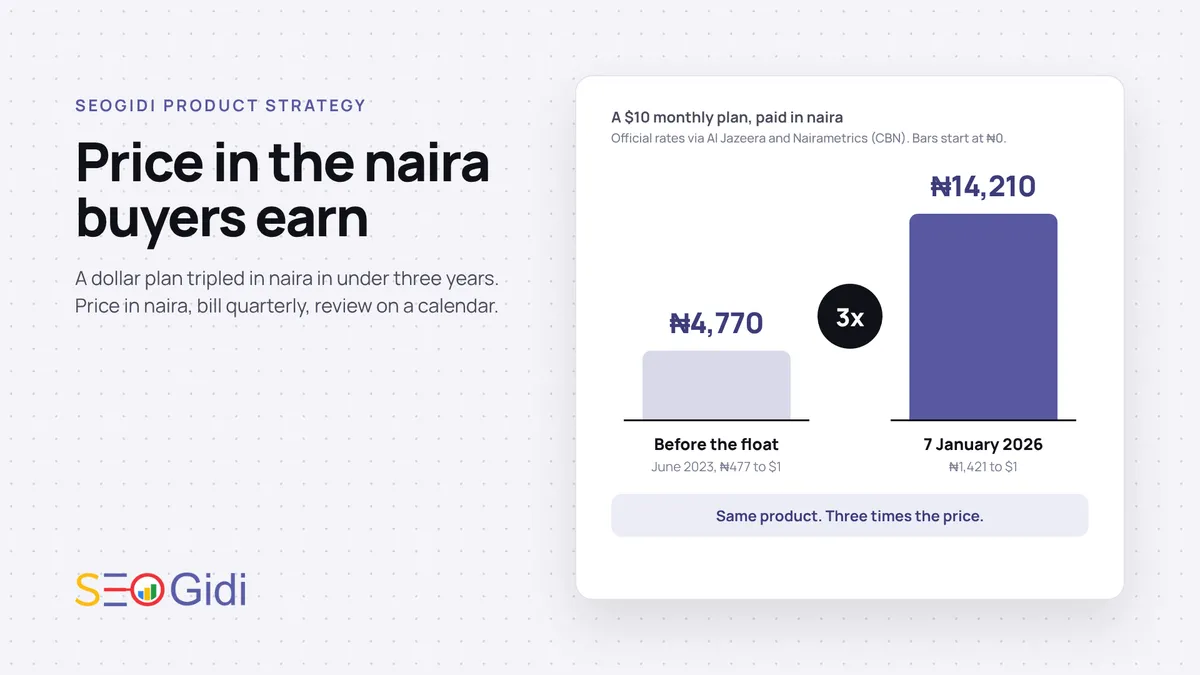
That last point is not theory. On 14 June 2023 the naira fell from 477 to 750 to the dollar on the official market in a single day, a drop of as much as 36%, as Al Jazeera reported. On 7 January 2026 it closed at ₦1,421 to the dollar, according to CBN data cited by Nairametrics. A $10 monthly plan that cost a Lagos customer about ₦4,770 before the float cost about ₦14,210 two and a half years later. Same product. Three times the price.
This guide is for founders building software for Nigerian and West African buyers. It covers the currency question, the freemium question, billing, tiers and anchors, and how to raise prices without losing the customers you fought for.
Naira or dollar pricing for SaaS: which should you choose?
Price in the currency your buyer earns in. That single rule settles most cases.
A boutique in Yaba, a clinic in Garki or a logistics firm in Port Harcourt earns naira and budgets in naira. A dollar price forces them to do exchange-rate arithmetic every month, and it moves their bill every time the rate moves. It also runs into card limits. In 2022, Zenith Bank and UBA cut the monthly web spending limit on naira debit cards from $100 to $20, as TechCabal reported. Limits have shifted since, but the lesson stuck with buyers: dollar subscriptions can fail at renewal for reasons that have nothing to do with your product.
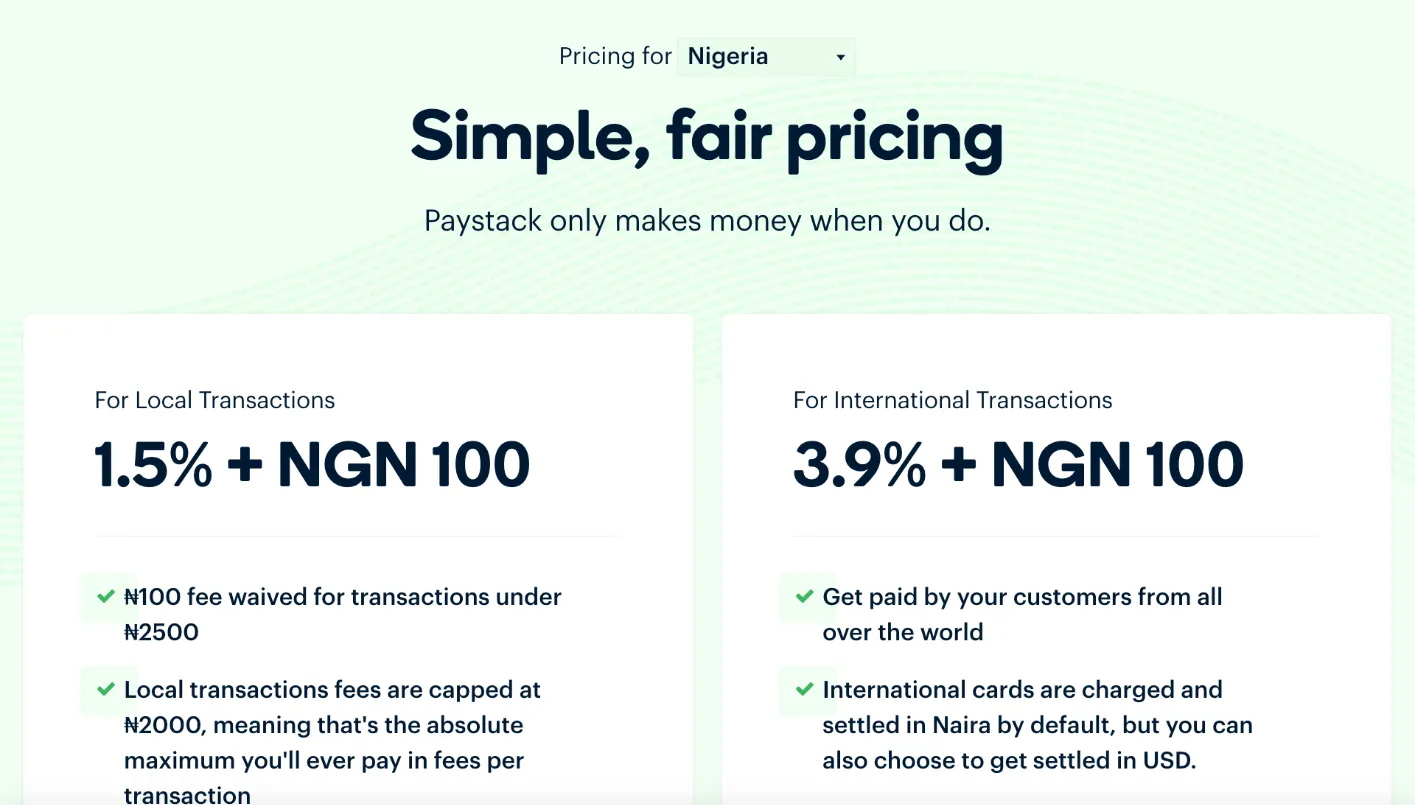
There is a fee cost too. Paystack charges 1.5% plus ₦100 on local transactions, capped at ₦2,000, and 3.9% plus ₦100 on international ones. Flutterwave lists 2% for local Nigerian collections and 4.8% for international cards, with 7.5% VAT on its fees.
| Your buyer | Earns in | Price in | Why |
|---|---|---|---|
| Nigerian SMEs and retailers | Naira | Naira | Predictable bill, local cards and transfers work |
| Nigerian enterprises and banks | Naira, some FX | Naira, with an FX review clause | Procurement budgets in naira; your dollar costs are protected by the clause |
| Exporters, remote workers, diaspora | Dollars or pounds | Dollars | They already think in hard currency |
| Pan-African or global teams | Mixed | Dollars, with local-currency checkout | One list price, local payment rails at checkout |
The hybrid in row two is worth explaining. If your hosting, APIs and tools are billed in dollars, a pure naira price exposes you every time the rate jumps. A clause that says “prices are reviewed if the official rate moves more than 15% from the contract date” protects your margin without pushing a dollar bill onto a naira buyer. The 15% figure is an illustration. Pick a trigger you can defend.
Why value-based pricing usually beats freemium in West Africa
Value-based pricing means you set the price from what the product is worth to the buyer, not from what it costs you or what a competitor in San Francisco charges. In a market where money is tight and every naira is questioned, this is the strongest argument you can make: “this tool costs ₦15,000 a month and saves you more than that in staff hours or lost orders.”
Freemium works against that argument. Lenny Rachitsky’s benchmarks put a good free-to-paid conversion rate at 3% to 5% for freemium self-serve products, against 8% to 12% for free trials. Those benchmarks come mostly from global software companies, and there is no strong reason to expect Nigerian conversion to be higher when budgets are tighter.
Take a hypothetical Lagos invoicing tool with 1,000 free users. At 4%, that is 40 paying customers. The other 960 still cost you server time billed in dollars, onboarding calls, and WhatsApp support messages at 10pm. Many of them will never pay because the free plan already solves their problem.
A trial, or a paid plan with a money-back promise, filters for buyers with intent. It also forces you to learn early whether people will pay at all, which is the only signal that matters before product-market fit is earned.
To find the value, ask customers what the problem costs them today. Hours spent reconciling transfers. Orders lost on WhatsApp because nobody replied. Stock that went missing. Talking to users before you set the number will tell you more than any pricing calculator.
Freemium vs paid in Africa: when free still makes sense
Freemium is not always wrong. It earns its place in a few specific situations:
- The free user brings in paying users. An invoicing tool whose invoices carry a “sent with” footer, or a scheduling link that every client sees, turns free users into a distribution channel.
- Network effects. If the product gets more useful as more people in a market use it, free users add value to paid ones.
- Your marginal cost is close to zero and support is self-serve. If a free user truly costs you nothing, the maths changes.
If none of those apply, use a 7 to 14 day trial, or a free tier with a hard ceiling (for example, the first 20 orders a month) that a growing business will hit quickly. Every free user you acquire also has a cost to reach. If your customer acquisition cost is rising, paying to acquire people who will never convert is the fastest way to burn a seed round.
Annual vs monthly billing: match how Nigerians actually pay
Your billing design matters as much as your price point, because of one fact about Nigerian payments. In 2023, bank transfers made up 58% of Paystack’s Nigerian transactions, up from 28% in 2022, while cards were 36%, according to TechCabal’s report on Paystack’s figures.
Now set that next to how automatic renewals work. Paystack’s subscription product supports card and direct debit (in Nigeria) only. So a monthly auto-renewing plan quietly excludes the majority of buyers who prefer to pay by transfer. Those customers have to remember to pay you every month, and every month is a chance to churn.
Longer billing periods reduce that friction. Bumpa, a commerce app built for Nigerian small businesses, is a useful public example. Its pricing page bills plans quarterly, bi-annually or annually, with no monthly option, and lists its Starter plan at ₦15,000 a quarter with savings of up to 20% on a yearly plan.
A sensible structure for most Nigerian SaaS:
| Billing period | Payment method | Discount | Best for |
|---|---|---|---|
| Monthly | Card or direct debit, auto-renew | None | Small teams testing you |
| Quarterly | Transfer or card | 5% to 10% | SMEs who budget per quarter |
| Annual | Transfer, invoice or card | 15% to 20% | Committed customers, enterprises |
Annual prepayment helps both sides in an inflationary economy. The customer locks in today’s price for a year. You receive cash now, which you can spend on dollar costs before the next move in the rate. Just price the discount so you are not locking yourself into a loss if your own costs rise mid-year.
Tiering and price anchoring for Nigerian buyers
Tiers let one product serve a market stall and a supermarket chain. The trick is to tie each tier to a value metric that grows with the customer: orders processed, invoices sent, staff seats, locations, or WhatsApp conversations handled. When the business grows, the bill grows with it, and the customer feels it is fair.
Here is an illustrative structure for a hypothetical inventory tool. The figures are examples, not benchmarks.
| Plan | Monthly price (illustration) | Limit | Who it suits |
|---|---|---|---|
| Starter | ₦9,500 | 1 location, 300 orders | Instagram and WhatsApp sellers |
| Growth | ₦24,000 | 3 locations, 2,000 orders, 5 staff | Shops with a physical store and online sales |
| Business | ₦60,000 | Unlimited locations, API, priority support | Chains and distributors |
Anchoring is the second lever. Buyers judge a price against the first number they see. Show the Business plan alongside the others, even if few people buy it, and Growth starts to look reasonable. Anchor against the cost of the problem too: if the tool replaces part of a salesperson’s day or prevents ₦50,000 of lost stock a month, put that comparison on the pricing page in plain words.
Show prices. “Contact us for pricing” on a small-business plan reads as “this will be expensive” to most Nigerian buyers, and it pushes them to a competitor whose price they can see. Keep “talk to us” for enterprise plans where procurement expects a conversation.
How to raise prices when the naira moves
You will have to raise prices. Plan for it before the first customer signs.
Global brands do it openly. Netflix raised its Nigerian prices in June 2025 for the third time since 2024, taking Premium from ₦7,000 to ₦8,500 a month, as Nairametrics reported. A company that size still treats Nigerian pricing as something to revisit, not a number set once.
A price-change policy you can publish:
- Review on a calendar. Every quarter, compare your dollar costs in naira against the last review. Move only when the gap is material.
- Give notice. At least 30 days by email and WhatsApp, with the reason in one sentence.
- Protect annual customers. They keep their price until renewal. This rewards the behaviour you want.
- Raise in steps. Two moderate increases a year are easier to accept than one shock.
- Add value with the increase where you can. A new feature or a higher limit softens the conversation.
This is the difference between building a product and building a business. The product works. The business survives because its prices keep up with its costs.
A SaaS pricing checklist for Nigerian founders
- Write down who pays and what currency they earn in. That decides naira or dollars.
- List your dollar costs (hosting, APIs, tools) and convert them at today’s rate. That is your floor.
- Interview at least ten target customers about what the problem costs them now. That is your ceiling.
- Choose one value metric that grows with the customer.
- Decide trial or freemium using the three conditions above. Default to a trial.
- Offer quarterly and annual plans payable by transfer, plus monthly by card.
- Set a published price review policy with a notice period.
- Put real prices on the page, and test one change at a time.
Frequently asked questions
Should I price my SaaS in naira or dollars?
Price in the currency your customer earns in. Nigerian SMEs and most local companies earn and budget in naira, so naira pricing removes exchange-rate friction and card limit failures. Use dollars for buyers who earn in hard currency, such as exporters or diaspora customers. For enterprise contracts, a naira price with an exchange-rate review clause protects your margin.
Is freemium a good model for startups in Africa?
Usually not for B2B tools sold to small businesses. Freemium conversion benchmarks sit around 3% to 5%, and free users still cost you hosting and support. It makes sense when free users bring in paying ones, when the product has network effects, or when a free user costs you almost nothing.
How much should a SaaS product cost in Nigeria?
There is no single right number. It depends on the value you create and who you sell to. As a public reference point, Bumpa’s Starter plan for small businesses is listed at ₦15,000 a quarter. Work out your cost floor in naira, ask customers what the problem costs them, and price between the two.
How do I collect recurring payments in Nigeria?
Paystack subscriptions support card and direct debit, and Paystack Payment Pages can collect subscription payments through a shared link without building a checkout. Because many Nigerians prefer bank transfers, offer quarterly or annual plans that customers can pay by transfer as well.
How often should I raise SaaS prices in an inflationary market?
Review prices every quarter against your costs in naira, and change them only when the gap is material. Give at least 30 days’ notice, and let annual customers keep their price until renewal. Smaller, regular changes are easier for customers to accept than one large increase.
Once your pricing page is ready, make sure buyers can find it, which is where SEO for SaaS companies comes in.
Reports, articles and industry research, by email
Original Nigerian search data a few times a year, new guides as they are published, and a short note when Google or Meta changes something that affects businesses here. No sales emails, unsubscribe in one click.

Want this done for your business?
Get a free SEO audit: rankings, technical issues, competitor gaps and the quickest wins, within 48 hours.