seogidi.com
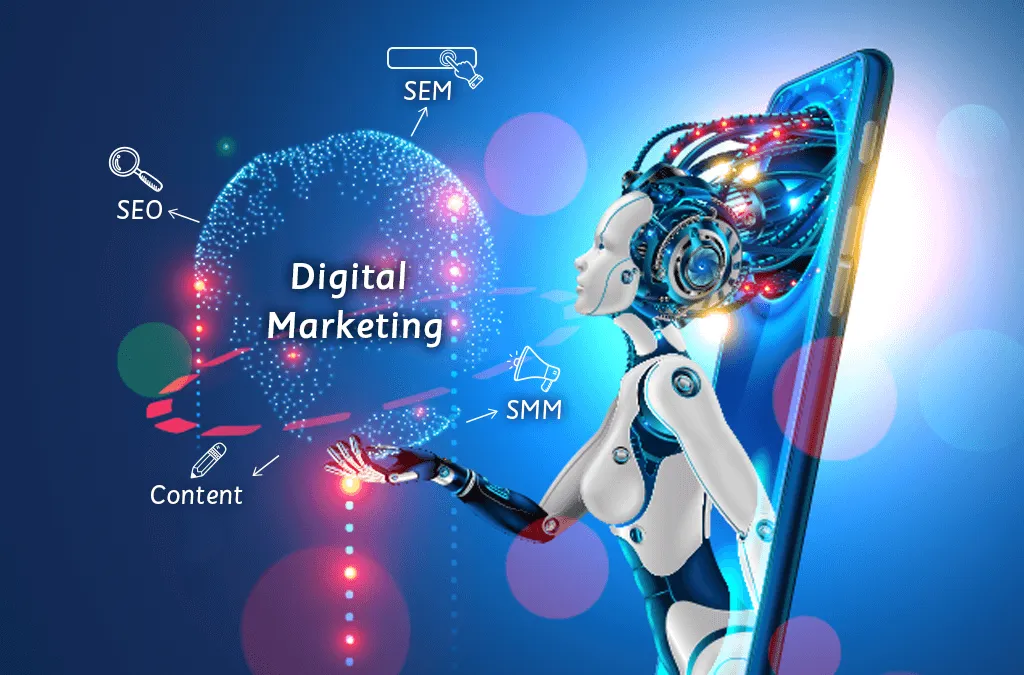
AI’s role in digital marketing is now mostly invisible: it decides who sees your ads, writes many of the variations they see, answers customer messages and, increasingly, answers search questions before anyone clicks through to your website. You use it whether you switched it on or not, because Google Ads, Meta and Google Search all run on it.
The useful question is which parts to hand over and which to keep. This guide covers where AI sits in marketing in late 2026, with the tools and the controls that still matter, and where it still fails. For the wider market picture, see our digital marketing trends for 2026 and 2027.
Where AI sits in marketing today
| Marketing job | What AI does | Examples | What you still control |
|---|---|---|---|
| Paid search | Matches ads to queries, writes headlines, picks landing pages | Google AI Max, Performance Max | Budget, negative keywords, brand exclusions, conversion data |
| Social ads | Chooses audiences and placements, generates creative | Meta Advantage+ | Offer, creative brief, what counts as a conversion |
| Content | Drafts, summarises, translates | ChatGPT, Gemini, Claude | Facts, angle, final edit |
| Customer service | Answers routine questions | WhatsApp chatbots, website chat | Escalation rules, tone, data consent |
| Search | Summarises answers above or instead of links | AI Overviews, AI Mode, ChatGPT search | Whether your pages are worth citing |
| Analytics | Spots patterns and predicts outcomes | Platform reporting, GA4 | Which questions get asked |
AI in ad buying and targeting
This is where AI has gone furthest. Google launched AI Max for Search campaigns in May 2025: it expands keywords beyond what you typed, writes ad text from your landing pages and sends people to whichever page it judges most relevant. Google says advertisers typically see 14% more conversions at a similar cost, based on its own data.
Meta is pushing harder. According to a Wall Street Journal report summarised by Marketing Dive, Meta wanted brands to be able to supply a product image and a budget by the end of 2026 and let AI build and target the entire ad. Since 16 December 2025 Meta has also used people’s conversations with Meta AI as a signal for ads, outside the UK, EU and South Korea.
What this means in practice:
- Your conversion data is the steering wheel. If you tell Google that every form submission is a sale, it will find you more form-fillers, including junk. Report real sales or qualified leads where you can.
- Exclusions matter more than targeting. Negative keywords and brand controls are how you stop the system spending in the wrong places.
- Creative is the new targeting. When the algorithm picks the audience, the ad itself decides who responds. Specific beats generic: “Same-day delivery in Ikeja and Lekki” outperforms “Quality products at affordable prices” as a filter for the right buyer.
AI-driven ads now appear inside AI answers too. Google began showing ads in AI Mode in Nigeria in October 2026, with no separate opt-out (PPC Land).
AI in content creation
AI can draft a blog post, ten caption options or a product description in seconds. Google does not ban AI-written content. Its guidance on generative AI content says it can help with research and structure, but warns that generating many pages without adding value can breach its spam policy on scaled content abuse. It also tells publishers to fact-check AI output, including titles, meta descriptions and alt text.
The pattern we see work: a person decides the angle and supplies what only they know (prices, local detail, customer questions, results), AI helps with drafting and formatting, and a person checks every claim before publishing. The pattern that fails is publishing AI drafts at volume on topics the business has no experience in.
Two related reads: generative SEO on using AI in the writing process, and why chasing AI-friendly formats is a mistake.
AI in customer conversations
Chatbots answer routine questions at any hour: opening times, delivery fees, order status. For Nigerian businesses the obvious home for this is WhatsApp, where most customer conversations already happen. Our State of Search in Nigeria 2026 research notes that Meta says WhatsApp handles 93% of its Meta AI prompts in Sub-Saharan Africa.
Keep a person in the loop for complaints, refunds and anything involving money. And if your bot collects names, phone numbers or addresses, you need a lawful basis under Nigeria’s data protection rules, the same as any other form.
AI in search: answering before the click
Search is where AI changes marketing most for businesses that do not run ads. Google’s AI Mode passed 1 billion monthly users in 2026, and Google has merged it with AI Overviews into one experience. ChatGPT reports roughly 900 million weekly users (ROIC.ai).
When the answer appears on the results page, fewer people click. Pew found US users clicked a link on 8% of visits with an AI summary against 15% without (Pew Research Center). Being named and cited inside the answer becomes a goal in itself. We tested this in which Nigerian businesses AI assistants recommend, and our generative engine optimisation service is built around it.
AI in analytics and prediction
AI helps spot patterns a person would miss in a spreadsheet: which products are bought together, which customers are about to stop buying, which hour of the day your ads convert. Ad platforms use the same modelling to estimate conversions they can no longer track directly because of consent rules.
Treat these numbers as estimates. Modelled conversions, predicted audiences and attribution reports are useful for direction, not as accounting. Cross-check them against your bank statement or payment dashboard.
What AI still gets wrong
- Facts. Google itself notes that generative models predict likely words rather than look up facts, so they can produce confident errors (Google Search Central).
- Local knowledge. A model may not know current Lagos rent, last month’s fuel price or that your Wuse branch moved.
- Brand voice. Unedited AI copy tends to sound like everyone else’s AI copy, which is the opposite of what a brand is for.
- Judgement about spend. Automated campaigns optimise toward the goal you set, even when the goal is wrong.
How a small business can start
- Pick one repetitive task. Drafting social captions, answering the ten most common WhatsApp questions or summarising customer reviews are good first candidates.
- Fix your measurement first. Before giving Google or Meta more control, make sure they are learning from real sales.
- Write your own brief. Give the AI your offer, prices, location and audience. Generic input gives generic output.
- Check everything that goes public. Names, prices, dates and claims.
- Review monthly. Look at what AI-run campaigns spent and what they brought in, in naira, not platform metrics.
Frequently asked questions
Can AI replace human marketers?
Not the parts that decide what to say and to whom. AI handles execution well: variations, bidding, routine replies. Strategy, offers, customer insight and accountability for results still need a person.
Is AI expensive for small businesses?
Most of it is already built into tools you pay for, such as Google Ads and Meta Ads Manager, and the main chat assistants have free tiers. The real cost is the time to brief, check and measure properly.
Does Google penalise AI-written content?
No, not for being AI-written. Google targets content made mainly to manipulate rankings, including mass-produced pages that add no value, whoever or whatever wrote them. Accuracy, originality and usefulness are what count.
What is the difference between AI marketing and automation?
Automation follows rules you set, such as sending an email two days after sign-up. AI makes its own decisions within limits, such as choosing who sees an ad. Most tools now combine both.
If you want help deciding where AI fits in your marketing, our SEO services start with a look at what you already have.
Sources
- Google: AI Max for Search campaigns
- Marketing Dive: Meta plans fully AI-automated ads by 2026
- Storyboard18: Meta to use AI chats to power ads from 16 December 2025
- PPC Land: Ads in AI Mode expand to 10 more countries
- Google Search Central: Guidance on using generative AI content
- Google: Q2 2026 earnings remarks from Sundar Pichai
- ROIC.ai: ChatGPT surpasses 900 million weekly users
- Pew Research Center: Google users click less when an AI summary appears
- SEOGidi: State of Search in Nigeria 2026
Reports, articles and industry research, by email
Original Nigerian search data a few times a year, new guides as they are published, and a short note when Google or Meta changes something that affects businesses here. No sales emails, unsubscribe in one click.

Want this done for your business?
Get a free SEO audit: rankings, technical issues, competitor gaps and the quickest wins, within 48 hours.